

How long kratom stays in your system depends on your body, your habits, the type of test, and whether anyone is actually looking for it.
For most people, kratom is detectable for about 5 to 7 days. But that number can stretch longer or shrink shorter depending on who you are and how you use it.
Let us walk you through exactly what affects detection time, how different tests work, and what you actually need to worry about.
The One Number You Need To Know: Half Life
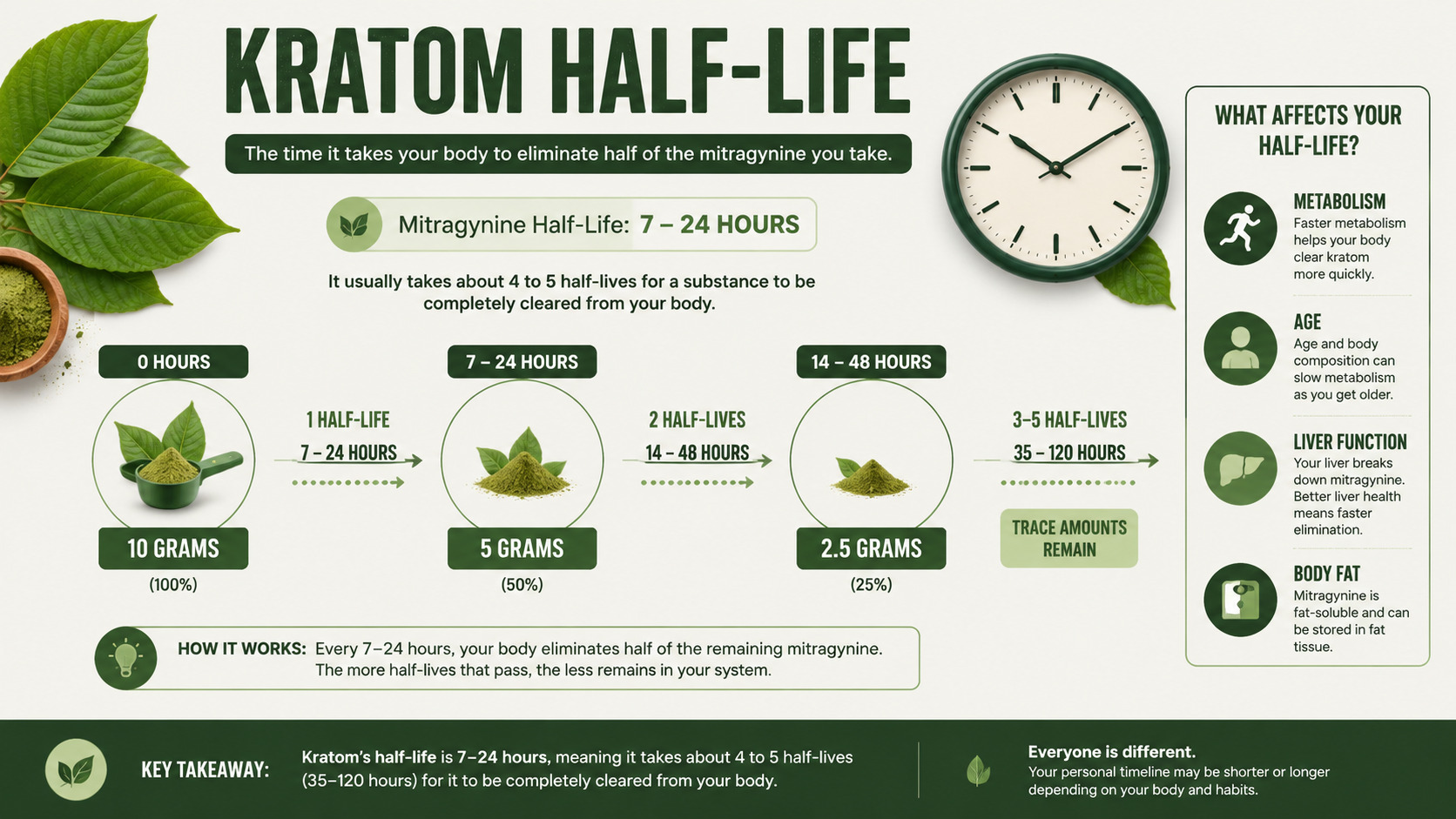
The half-life is the first number to understand when learning how long kratom stays in your system, but it can change based on use, body factors, and test type.
Before we talk about detection windows, there is one concept that makes everything else make sense. It is called half life.
Half life is the time it takes for your body to get rid of half of a substance you took.
For kratom’s main active compound, which is called mitragynine, the half life is roughly 7 to 24 hours. That is a pretty wide range, and here is why. Your metabolism, age, body fat and even your liver function all play a role in how fast or slow you process kratom.
Here is a simple way to think about it. If you take 10 grams of kratom and your half life is 12 hours, you will still have 5 grams in your system half a day later. After another 12 hours, you will have 2.5 grams, and so on.
It usually takes about 4 to 5 half lives for a substance to be completely cleared from your body. That math is why most people test positive for about a week.
Detection Windows By Test Type
Not all drug tests are the same. Some look for kratom in urine, others use blood or saliva. Each one has a different timeline.
The following table can help you understand in a better way:
| Test Type | Detection Window | How Common Is It? |
|---|---|---|
| Urine | 1 to 7 days (up to 9 days for heavy users) | Most common method for specialized testing |
| Blood | Approximately 24 hours | Rare, invasive, short window |
| Saliva | Less than 24 hours | Very rarely used for kratom |
| Hair | Up to 90 days | Uncommon, expensive, requires specialized lab |
These detection windows only apply if someone is actually looking for kratom. Standard workplace drug tests do not include kratom.
Urine Testing
Urine is the most common way labs test for kratom when they decide to look for it. In occasional users, kratom shows up in urine for about 1 to 5 days. In daily heavy users, it can be detected for up to 7 days or even a bit longer. For more details, read our full guide on does kratom show up in a urine test.
Blood Testing
Blood tests for kratom are pretty rare. They are invasive, expensive, and the detection window is very short. Kratom is mainly detectable in blood for only about 24 hours after use. Because of that short window, blood tests are not very practical for most situations. You would have to catch someone very soon after they took kratom.
Saliva Testing
Saliva tests for kratom are even rarer. The detection window is less than 24 hours, and most standard saliva panels do not include kratom at all.
Hair Testing
Hair tests can theoretically detect kratom for up to 90 days. But here is the catch. This type of testing is expensive and is not widely available for kratom specifically. It is rarely used outside of very specific circumstances.
What Affects How Long Kratom Stays In Your System?
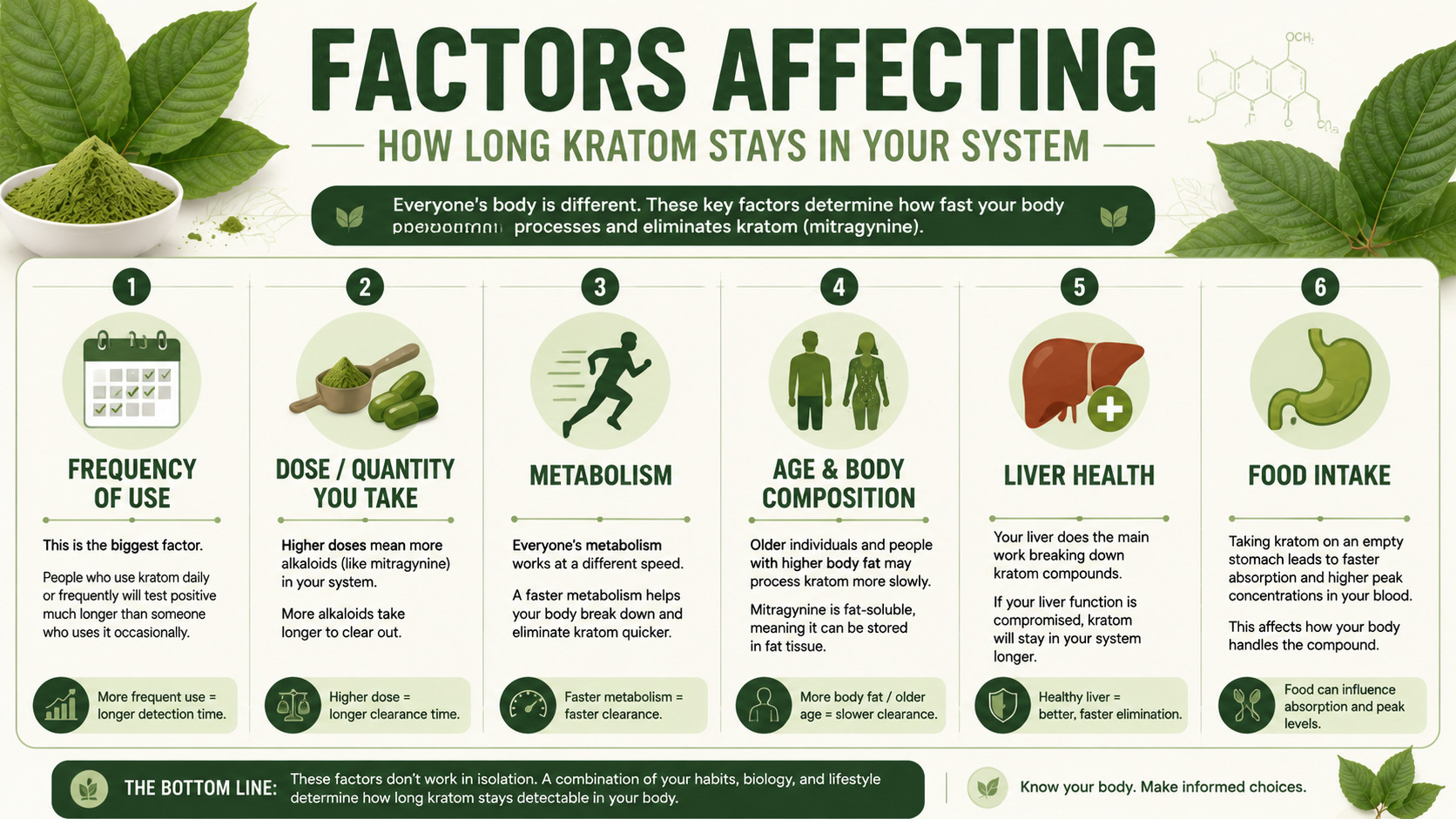
Not everyone processes kratom at the same speed. Here are the main factors that change your personal detection window.
Time Duration of Your Use – This is the biggest factor. Someone who takes kratom once a week will clear it much faster than someone who takes it every day. Heavy and frequent users can test positive for 9 days or longer.
Quantity You Take – Higher doses mean more alkaloids in your system. More alkaloids take longer to clear out.
Metabolism – Everyone’s body works at a different speed. A faster metabolism means kratom leaves your system faster.
Age and Body Metabolism – Older individuals and people with higher body fat may process kratom more slowly. Mitragynine is fat soluble, meaning it can be stored in fat tissue.
Liver Health – Your liver does most of the work breaking down kratom. If your liver function is compromised, kratom will stay in your system longer.
Your Food Intake – Taking kratom on an empty stomach leads to faster absorption and higher peak concentrations in your blood. This does not necessarily change detection windows, but it affects how your body handles the compound.
Will Kratom Show Up On A Standard Drug Test?
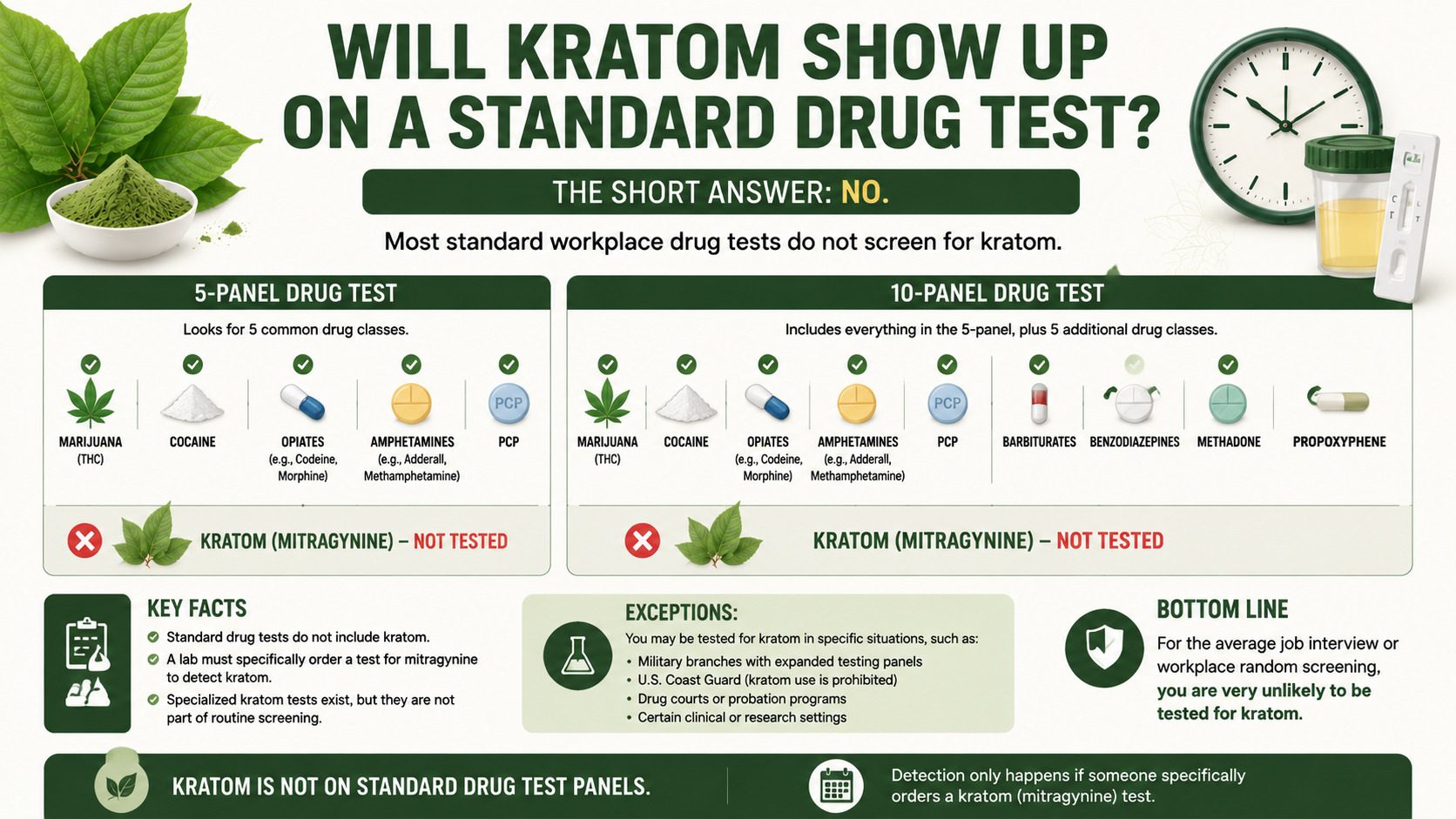
This is the question almost everyone actually wants answered. It’s a no. Standard drug tests do not screen for kratom. You can also read our detailed guide on does kratom show up on a drug test for a closer look at standard testing.
Most employers use a 5 panel or 10 panel drug test. Those tests look for things like marijuana, cocaine, opiates, amphetamines, and PCP. Kratom is not on those panels.
A lab has to specifically order a test for mitragynine to detect kratom. Those specialized tests exist, but they are not part of routine screening.
There are a few exceptions, though. The United States Coast Guard recently issued a lawful general order prohibiting all kratom use for military personnel. Some branches of the military have added kratom to their expanded testing panels. Drug courts and probation programs may also order specialized kratom testing in certain cases.
But for the average job interview or workplace random screening? You are very unlikely to be tested for kratom.
Understand the Note On False Positives
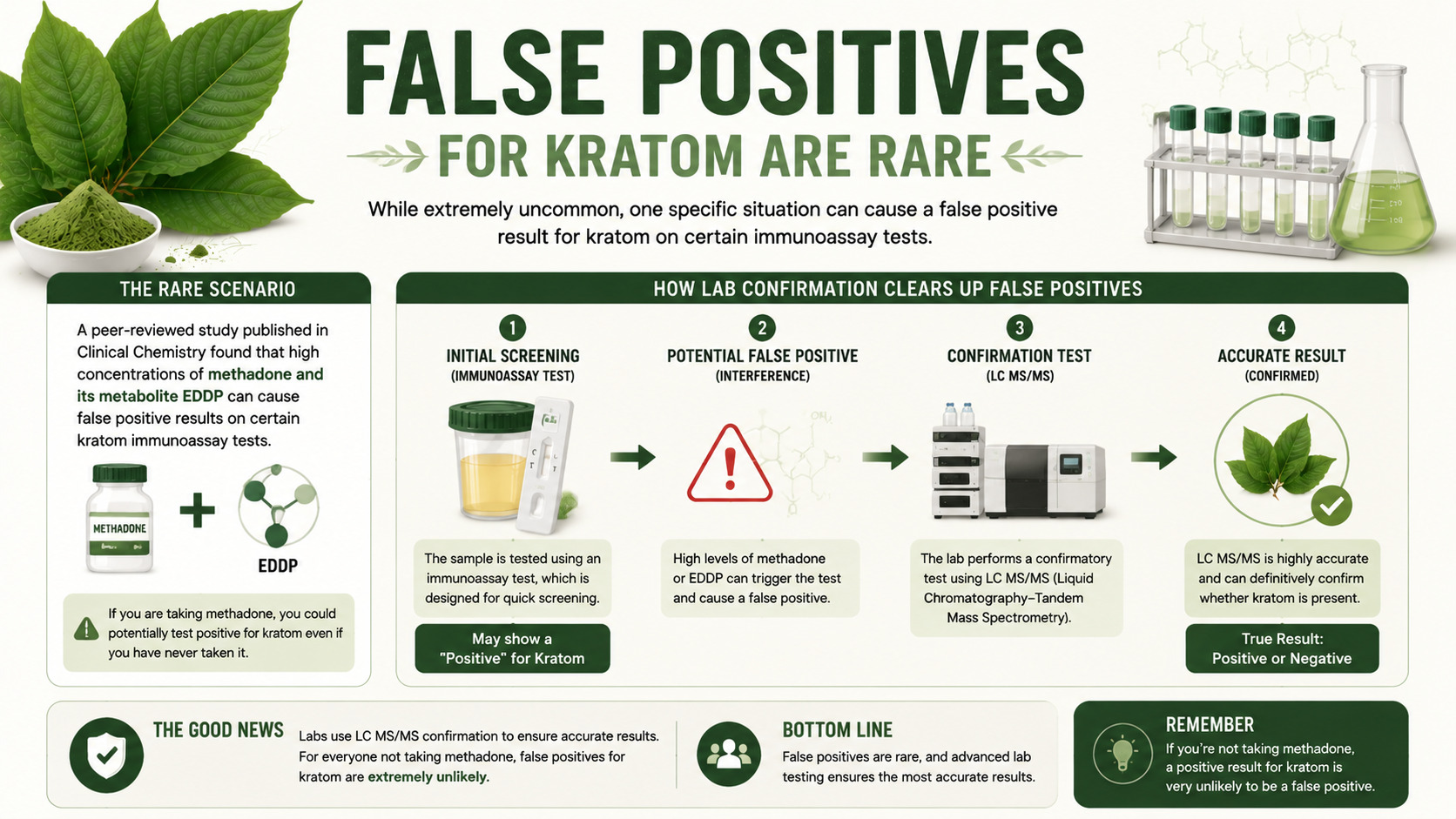
There is one rare scenario worth mentioning. A peer reviewed study published in Clinical Chemistry found that high concentrations of methadone and its metabolite EDDP can cause false positive results on certain kratom immunoassay tests.
What does that mean for you? If you are taking methadone, you could potentially test positive for kratom even if you have never taken it. The good news is that labs use a second confirmation test called LC MS/MS that clears up any false positives. For everyone else, false positives for kratom are extremely unlikely.
Final Words
So, finally, Most standard drug tests do not include kratom. You are not going to fail a routine pre employment screening because of kratom. If you are in a situation where specialized testing is possible like probation, drug court, or military service then you should be aware that detection windows exist and they vary by test type. If you plan to buy kratom, choose quality products from a trusted source and always read product details first.
FAQs
1. Does kratom show up on a 5 panel drug test?
No. A standard 5 panel test looks for marijuana, cocaine, amphetamines, opiates, and PCP. Kratom is not on that list.
2. How long does kratom stay in your urine?
For occasional users, about 1 to 5 days. For daily heavy users, up to 7 days or sometimes a bit longer.
3. Can kratom cause a false positive for opioids?
It is very unlikely. Standard opioid tests are designed to detect morphine and codeine. Kratom has a different chemical structure. However, rare false positives for methadone have been documented with certain testing methods.
4. How long does kratom stay in your blood?
About 24 hours. Blood tests for kratom are rare because the detection window is so short and the procedure is invasive.
5. Does the military test for kratom?
The Coast Guard has explicitly prohibited kratom use, and other military branches have issued warnings. Service members should assume that kratom could be tested in expanded panels.
6. Will kratom show up on a hair follicle test?
Theoretically, yes, for up to 90 days. But hair testing for kratom is uncommon, expensive, and rarely performed.
7. How can I get kratom out of your system faster?
There is no proven way to speed up the process significantly. Staying hydrated, eating well, and giving your body time are the only reliable methods. Be very skeptical of any product that claims to “flush” kratom out of your system quickly.


