
Responsible Use Toolkit
Free printable and fillable trackers, planners, journals and checklists.
Last checked: 10/12/26
They print on an ordinary home printer, one page each, and most PDF apps on a computer, phone or tablet can fill them in and save a copy. The whole section is here as a single document as well. Nothing here asks you to sign up for anything, and nothing arrives filled in for you. The other pages in this section tell you what is documented. This one hands you something to use.
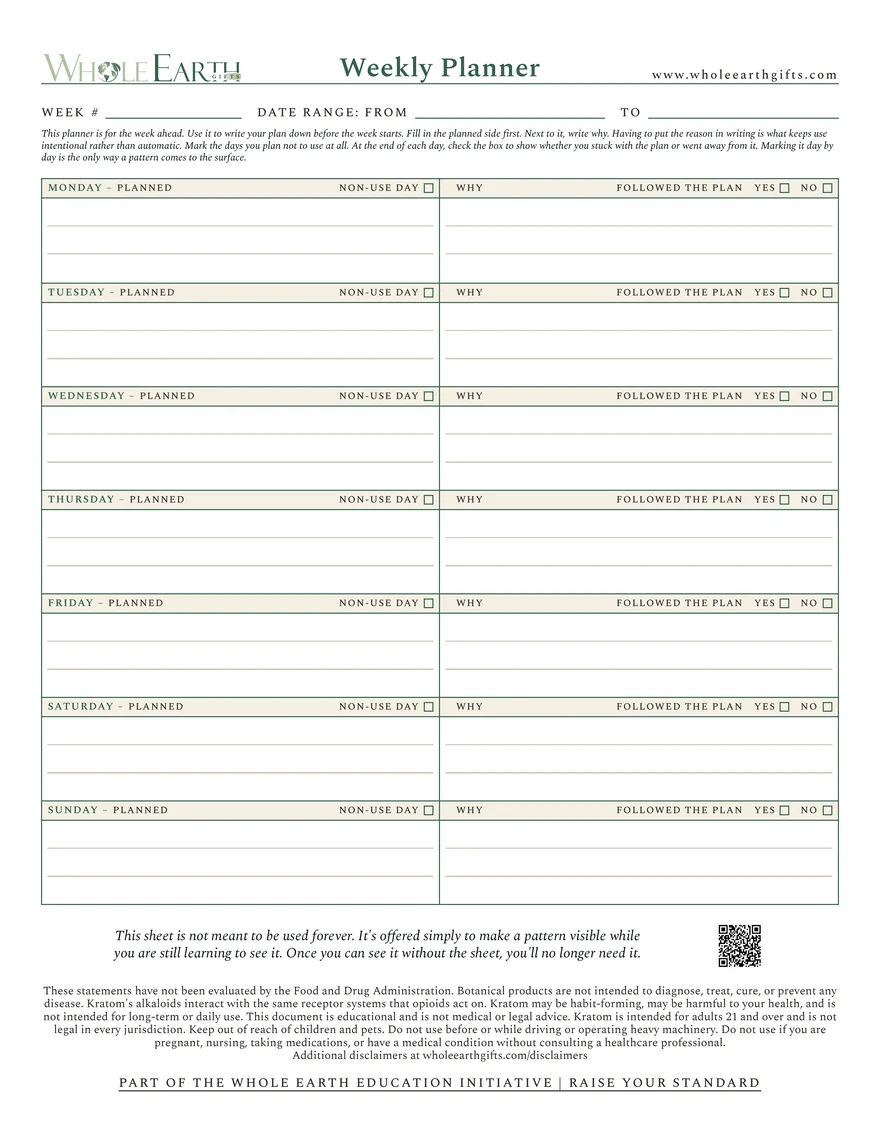
Weekly Planner
Write the week down before it happens: what you plan, why you decided on it, and which days are non-use days. At the end you mark whether the plan held, and the two halves won’t always match.

Servings Tracker
A whole month on one page, recorded as each serving happens rather than rebuilt afterward. Nothing on it asks how it went, because a sheet that asks you to rate an experience teaches you what to expect from the next one.
Reflection Journal
The only sheet that asks you to think rather than record, filled in at the end of each day. Most of what it asks about isn’t kratom at all: how you ate, how you slept, whether you drank enough water, whether you moved.
Rotation Planner
For anyone alternating among products, with the week set before it starts rather than chosen each morning. Deciding in advance is the whole point, because a rotation you improvise is a description of what you felt like doing.
Break Planner
For a week when a break is planned. The top block is what the break is and why you decided on it, and the bottom block is what happens when it ends, filled in before the break starts.
Tapering Planner
Holds a plan you’ve already made, written somewhere you and a physician can both look at it. It doesn’t tell anybody how much to take, how often, or how quickly to come off.
Household Checklist
The only sheet that protects somebody other than the person filling it in. Where things are kept, whether the original label is on them, whether a child or an animal could reach them, and who else in the house knows what to do.
Travel Checklist
One row for each place a trip puts you in: every state you drive through, every county on the route, every airport you land at, including the one where you only lay over. Each row has room for the office you called, who you spoke with, and what they told you.
Responsible Use Guide, Print Edition
This one is different. It isn’t a journal or a planner, it’s a summary of every article in the section, each one with a reference to the article behind it. Read it on a screen, print it, or hand it to somebody who isn’t going to read a website.
What Writing It Down Actually Does
Intentions do not survive a busy month. Paper does.
Memory is generous. A change that happens over months arrives feeling like it was always this way, because that’s what memory is built to do. A brain that stored every ordinary Tuesday in full would be useless. So the smoothing is not a flaw in you, and none of these sheets is here to catch you out.
What a sheet does that memory cannot is hold what you thought at the time, written before you knew how the month turned out. Compare a month to the month before it and you get an answer nobody else can give you. It is a record of one person, and you’re the person.
Nothing here scores you. There’s nothing to complete, and nothing congratulates you at the end.
What None of Them Do
No sheet here prints an amount, a frequency, a schedule or a threshold. The only numbers on any of them are the ones you write in yourself.
That’s not caution and it’s not a legal position. It’s that nobody can know it. Alkaloid content varies between products and between batches. People differ in body weight, liver enzymes, medications, tolerance and history. A number printed by the company that sold you the product would be a guess wearing the clothes of guidance. You would be the one carrying the result of it.
They’re also not a program. No sheet tells you whether something is allowed, whether you are doing well, or what to do next. They record. Reading the record is your job, and so is what you do about it.
How to Use Them
They’re a sequence rather than a set, and almost nobody needs more than one at a time. A person uses the Weekly Planner while things are running as they are. They move to the Break Planner when a break is planned. They pick up the Tapering Planner if a physician is involved in coming off. Take the one that matches what you are actually doing.
A sheet you fill in for one week and then abandon has done something anyway. One week of honest entries tells you more than a month of remembering. And a sheet that stops being useful has finished its job, because you are meant to stop needing it.
Taking kratom every day without thinking about it is the pattern every page in this section warns about. These exist to make that harder to do by accident.
Every topic these sheets belong to is covered at length in Responsible Kratom Use.