
About Whole Earth Gifts
Our founder, Theron Rodriguez, spent thirty years in the music industry. He started at nineteen as a clueless stagehand and worked his way up to Director of Production for the second largest concert promoter on the planet. In March of 2020, large gatherings became the first thing in the country to shut down, and thirty years came to a screeching halt inside a week.
He was one of the first people sent home, and he spent that strange spring on the phone almost every day with two people: his brother, Devin Rodriguez, and his friend Thomas Dowdy. Thomas and Theron go back to a band called Spoonfed Tribe. Both worked with the band, and on tour with it around 1999, the two of them met Payam Panbechi at sunrise outside a tour bus in Lubbock. Payam went on to found KR8OM. Theron and Thomas have stayed close ever since, and so have Thomas and Payam.
A family friend introduced him to kratom around the same time. With nothing else to do, he started reading, and he did not stop for months. Whole Earth Gifts opened that June, with the three of them behind it and one brand on the shelf, KR8OM.
Two things stood out in all that reading. People cared about this plant far more than anyone selling it seemed to. And almost nobody in the industry was telling them the truth about it.
When the world went back to work, so did Devin and Thomas. For a while, with the pandemic not yet over, Theron did too. The company kept running, but it got very little attention for the better part of a year. So he had a decision to make: shut it down, sell it, or go all in. After thirty years in the music business, he was ready for a change. When the pandemic ended, he did not go back.
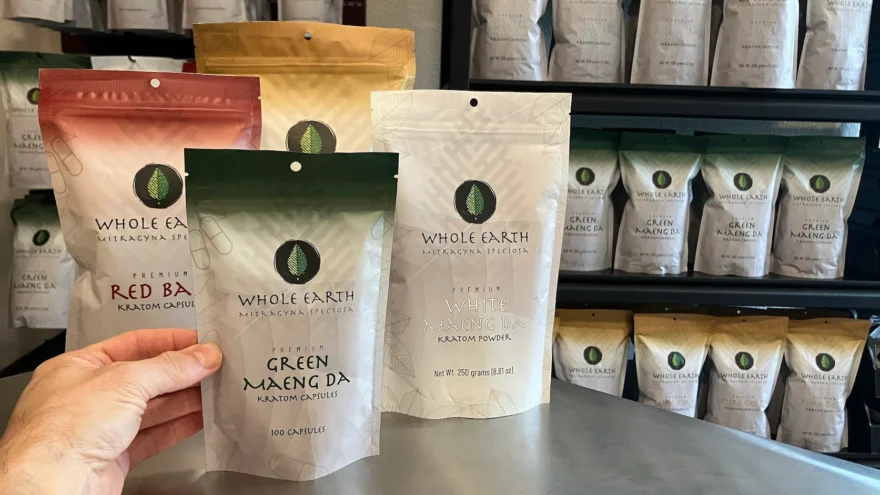
Devin and Thomas stepped out, and in 2024 Theron relaunched the company on his own as Whole Earth Gifts 2.0. Part of the relaunch was a hard look at the shelf. About 80 percent of sales were coming from about 20 percent of the products, so the lineup was cut down to the best sellers. The story of the house brand is on our Whole Earth profile.
The person who relaunched this company is the person running it. That is not a sentimental detail. Try calling most kratom vendors and see who picks up, or whether anyone does. The company has never been sold, the phone number goes to people who know the catalog, and the person whose name is on the disclosures is the person running the place.
The problem with how kratom gets sold
Walk into most kratom shops, physical or online, and you will be handed a chart. Red does this. White does that. Green is for the other thing. It is confident, it is specific, and it is the same chart on every site, because everyone copied it from everyone else.
Here is what that chart leaves out.
People are not interchangeable. The same product, the same amount, on two different people, does not land the same way. Body chemistry, tolerance, what you ate, what else you take, how you sleep. Just because something worked well for someone else does not mean it will work the same way for you.
Finding what suits you takes time. Most people try several things before they settle. That is normal, it is not a sign you did something wrong, and any vendor implying you should get it right on the first order is selling certainty they do not have.
Kratom is not a solution to anything by itself. It sits inside the rest of your life, next to how much water you drink, how much you move, and how much you sleep. Anyone trying to sell you on the idea that a single plant will solve your problems is trying to get your money.
And it carries real risk. Kratom may be habit-forming. Stopping after regular use can be difficult. Constipation is common. Natural does not mean harmless, and it does not mean you get to be careless.
We say the quiet parts out loud because this company is built on trust, and trust does not survive a surprise six months in.
There is also a legal reason we say things the way we do, and it is worth being upfront about. The FDA has not approved kratom for any therapeutic use, and no company is permitted to tell you it treats, cures, or improves anything. Most of the industry says it anyway. We do not, and you should read that as a signal about the rest of what we tell you.
So we describe our products the way you would describe a coffee or a tea: what color it is, where the leaf came from, how it was processed, how fine it is milled, what is on the lab report. Facts about the material in the package.
What kratom does for you can only be determined by you, through your own experience.
What we actually do
We are an education platform that also sells kratom. That is not a slogan, it is the ratio of the work.
The Whole Earth Education Initiative is three things. The Kratom Guide covers what kratom is, where it comes from, the forms it is sold in, and where it is legal. Responsible Kratom Use covers what kratom does to a body over time and what the risks actually are. Kratom University is a structured course, four levels and twenty-four lessons, that takes someone from knowing nothing to genuinely understanding what they are buying.
All of it is free and none of it requires a purchase. No other vendor in this category has built anything close to it, and that is not a boast, it is just what we found when we looked.
How our house kratom is tested
Whole Earth branded kratom is tested three separate times before it reaches you, by three different parties.
The farmer in Indonesia mills the leaf, has it tested, and ships it. It goes to the GMP qualified facility that packages it for us, and they have it tested again when it arrives, before anything goes into our packaging. It ships to us, and we have it tested a third time before it goes up for sale.
Every one of those tests goes to an independent third-party lab. Nobody in that chain tests their own product.
For the brands we carry alongside our own, we require current third-party lab results and we read them. If a batch does not have a current COA, it does not go on the shelf.
How we choose the brands we carry
We talk to the company. We look at how they operate, what their lab results actually say, how they behave publicly, and what their customers have said about them over time. We buy the product and try it ourselves.
Whole Earth, our house brand, is AKA GMP Qualified, and so is 1836 Kratom, one of the brands we carry.
That designation is not a logo a company can buy. It requires an independent third-party audit of the facility and its processes, repeated every year, and it is entirely voluntary. No law requires any of it, which is precisely why it means something. It qualifies a facility and its procedures rather than an individual package of powder, which is why lab testing sits alongside it rather than being replaced by it. What the program covers, and what it does not, is laid out on our AKA GMP Qualified page.
The same association runs a second program aimed at vendors who market kratom with illegal health claims, asking customers to report them so the FDA can act. Read that again. The industry’s own advocacy organization is asking customers to report vendors for making claims about what kratom does to a person. That is not a fringe position and it is not ours alone. It is the standard, and most of this industry ignores it.
What being transparent costs
Most companies that quietly delete reviews delete the bad ones.
We delete the good ones. When a review comes in saying something positive that crosses an FDA line, we do not publish it. There have been dozens we could not use, and nearly every one was four or five stars. Not one negative review has ever been touched.
They come down because they make claims about what kratom did for the person who wrote them, and a review published on our site counts as our claim as far as the FDA is concerned. A customer is allowed to believe whatever they want about their own experience. We are not allowed to publish it as advertising, and that is exactly what it becomes the moment it sits on our product page.
Glowing reviews get held back every month for this reason. Nobody has ever complained about it, because nobody ever sees what did not go up.
So when you read reviews on this site, you are reading the ones that cleared a standard. That is a smaller set than what people actually sent us, and it is the honest version of what we are allowed to show you.
Customer service
Things go wrong here as often as they go wrong anywhere. Packages get lost. Tracking emails land in spam. Someone needs an order rushed for a reason they did not see coming. Someone tries a product and it turns out not to be for them. Every company selling physical goods deals with all of it, because the common denominator is people and logistics, and neither has ever been perfect.
What separates companies is not whether problems happen. It is what happens next.
Call here and someone picks up. Not a phone tree, not a bot, not somebody hired last week reading from a script. Send an email after hours and it gets answered. Ask about a return, a lost package, a tracking number, or a product question, and you get an actual answer, not a ticket number and a wait.
If you would rather have time set aside than catch us between calls, book a free one-on-one consultation. You will be talking to the person who owns the company, and there is no obligation to buy anything.
Our older customers tell us it reminds them of how this used to work. Something needed sorting out, so you picked up the phone, talked to a person who knew the answer, worked it out, and got on with your day. No portal, no chat queue, no case number.
We never set out to be vintage. It just turned out the old way works better for a lot of people.
For everyone else, we have all the modern conveniences too. A virtual assistant that runs around the clock, a contact form, email. And if you want to go really old school, you can always write us a letter.
Where this is going
Kratom ended up behind the counter at smoke shops, sitting next to the pipes and the vape cartridges. It did not have to go that way. There is nothing about a leaf that decides which aisle it lands in. That was decided by how it has been sold, by companies making claims they could not back, in packaging designed to look like something you take to get high.
It belongs on the shelf with the ashwagandha and the echinacea at your local organic grocery store. Same aisle, same standing, same expectation that the label tells the truth. We are a long way from that. But if enough of this industry does it right, it gets there.
We would rather be part of the solution than part of the problem. That choice costs us sales every month, yet we make it anyway, because how this plant is treated twenty years from now matters more than how much we sell this week.