
Kanna vs Kratom
Kanna is a small creeping succulent from the dry west of South Africa. Kratom is a tree from the wet lowlands of Southeast Asia. The two plants belong to unrelated families and grow on different continents, in opposite climates. They share one thing, and it’s hidden in the old names. Kanna’s Afrikaans name, kougoed, means something to chew. Kratom leaf was chewed fresh in Southeast Asia long before anyone sold it in the United States.
Here’s what this page adds. The first permit issued under South Africa’s bioprospecting law went to a company developing kanna. It pays a royalty to the San and Nama communities whose knowledge the trade rests on. Kanna also carries a name that botanists no longer accept. Both facts say more about these two plants than a list of effects would.
What is the difference between kanna and kratom?
They’re unrelated plants from opposite sides of the Indian Ocean, and people use different parts of each.
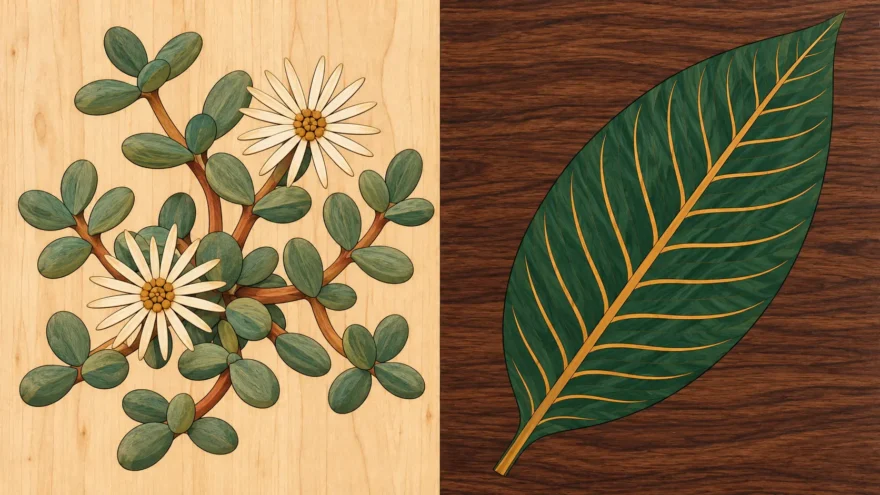
Kanna is Sceletium tortuosum, in the Aizoaceae family of succulents. South Africa’s National Biodiversity Institute describes a plant that climbs or creeps, with slender branches that turn slightly woody with age. It lives about three to five years. It grows from Namaqualand east to Montagu and Aberdeen, often on quartz patches in the partial shade of shrubs. Its flowers are white, pale yellow, pale salmon or pale pink. The trade uses the whole plant above the soil.
The genus name comes from the Latin word for a skeleton. When the leaves dry, their veins stay behind like a frame. In dry spells those dead leaves close around the young ones and shelter them. Linnaeus gave the plant its first Latin name in 1753.
Kratom is Mitragyna speciosa, an evergreen tree in the Rubiaceae family, the same family as coffee. It grows in wet, often flooded soil along rivers and reaches roughly 13 to 52 feet. Only its leaf is used. Every kratom product we sell starts as that leaf, and our milled leaf is at buy kratom powder.
What is kanna’s real name?
Botanists now file it under a different one.
Most kanna products say Sceletium tortuosum on the label. The Global Biodiversity Information Facility, an international species database, lists that name as a synonym. The accepted name is Mesembryanthemum tortuosum, the one Linnaeus gave it. A newer page from South Africa’s Biodiversity Institute uses it too. Both names point to the same plant, and research papers use either one.
The confusion runs deeper than the name. A 2022 study profiled kanna and three sister species collected across the Succulent Karoo. The authors wrote that the four aren’t easy to tell apart by looks alone. They told them apart by their chemistry instead, and found that the chemical profiles also changed from place to place. A label names a species. A laboratory is what confirms it.
What is in each plant?
Two different families of alkaloids, with nothing in common but the word.
Kanna’s best-known compound is mesembrine, along with a group of close relatives. Kratom’s compounds are indole alkaloids, led by mitragynine. The two groups aren’t related. A figure on a kanna lab report and a figure on a kratom lab report don’t measure the same thing. Kratom Alkaloids covers what’s in the leaf.
Both plants vary. Kratom’s mitragynine shifts with light, soil and water, and with how the leaf is dried after picking. Kanna’s chemistry shifts from one wild population to the next, which is what that 2022 study found.
How was each one traditionally used?
Both were chewed, and both were traded long before they reached a store shelf.
South Africa’s government set down part of the history in 2010. The Khoi of the Little Karoo used one word, kanna, for the plant and for the eland, the large antelope at the center of San culture. That is where the region’s old name, Kannaland, came from. In 1662 Jan van Riebeeck bartered with local people and received kanna and sheep. In 1773 the Swedish botanist Carl Peter Thunberg recorded that the Namaqua chewed its stems and roots.
A 2021 review describes the traditional preparation. The plant was crushed, sealed in a bag and left in the hot sun for about eight days, mixed now and then. Then it was spread on a flat rock to dry into light brown clumps. Some people simply crushed the fresh plant and dried it in the sun.
Kratom’s record runs on a different timeline. In Southeast Asia the fresh leaf was chewed and brewed for longer than the written record reaches. Its arrival in the United States came far later.
Who controls the trade in each plant?
In South Africa, kanna comes with a permit and a royalty.
South Africa’s Biodiversity Act of 2004 says nobody may carry out commercial bioprospecting on an indigenous plant without a permit. The same goes for exporting one for research. The Bioprospecting, Access and Benefit Sharing Regulations took effect in 2008. On October 1, 2010, the government handed over the first permit issued under those rules. It went to HGH Pharmaceuticals, for kanna.
The terms were read out that day. The company pays the South African San Council an annual royalty on its net proceeds. The Council passes half of what it receives to two Nama communities in Namaqualand, Paulshoek and Nourivier. The plant for that product came from contracted growers rather than the wild. That matters. The Biodiversity Institute reports heavy pressure on wild kanna from harvesting, although the species itself isn’t listed as threatened.
Kratom’s country of origin regulates something different. Indonesia sets the rules on what form the leaf may leave in and who may ship it. Where Does Kratom Come From explains how that shapes the trade.
How is each one sold in the United States?
Differently, and not with the same standing.
Kanna is sold here as a dietary supplement. The National Institutes of Health’s Dietary Supplement Label Database held 72 labels listing Sceletium when we checked on 09/18/26.
Kratom’s federal position is its own subject. FDA’s view is that kratom isn’t lawfully marketed as a drug, as a dietary ingredient, or as an additive in food. Is Kratom Legal Federally lays that out.
Can kanna and kratom be taken together?
Nobody has studied it.
We searched PubMed on 09/18/26 for any study of kanna and kratom used together in people, and found none. The few papers that mention both are broad reviews or lab methods. That doesn’t mean there’s no risk. It means nobody has measured it.
Combining kratom with anything else raises the stakes, and kratom and alcohol explains why. We don’t sell kanna, and we don’t sell any product that combines it with kratom.
Kanna and kratom sit on different continents, in different families, under different laws. The habit worth carrying from one to the other is asking what’s in the bag, and who says so.
Back to Kratom Comparisons or to the Kratom Guide.