
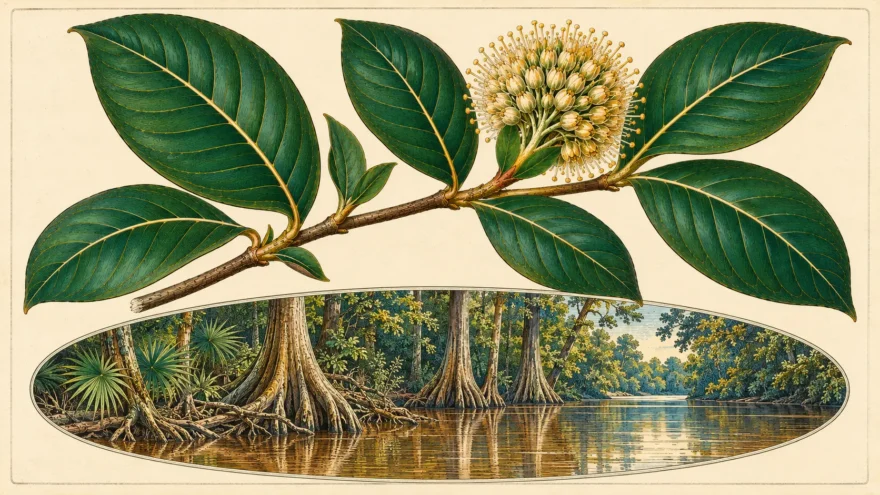
Where Does Kratom Come From?
Almost all the kratom sold in the United States comes off riverbanks on one island, Borneo. Most of it comes from one Indonesian province, West Kalimantan. It is picked and dried by the farmers who grow it. It is milled near where it grew and shipped as powder. The tree grows across a far wider stretch of Southeast Asia than that. The trade does not.
Where a leaf came from matters less than what happened to it in the week after picking. That is the part of this subject nobody prints. It’s where this page spends most of its time.
What happens between the tree and the container?
Harvest, drying, milling, packing. Almost all of it happens at origin, by hand. The drying step is where quality is won or lost, and it is also what the color name on a package reports, which is covered in kratom colors.
Indonesia’s Ministry of Finance published an evaluation of West Kalimantan kratom powder exports. It’s unusually blunt. It records that 38 containers of kratom powder were rejected by American importers and sent back. The reasons given were low mitragynine, salmonella and heavy metals. One more was adulteration, with wheat flour and powdered leaf from other plants.
The leaf itself was not the problem. Provincial testing of freshly picked leaf in Kapuas Hulu found no meaningful microbial contamination. Mercury and lead sat below limits. Cadmium was the one metal running high. What the same report describes is what happens next. Leaf dried at the roadside, uncovered, exposed to dust and animal droppings. Collection and packing done without clean gloves. Locally built grinding machinery introducing metal.
That is a processing problem rather than a farming problem, and it’s fixable. West Kalimantan’s answer was to build its own laboratory. It tests for microbes, moisture, heavy metals and mitragynine content, so growers can price their material on a number rather than on a buyer’s word. What that number covers is the subject of kratom lab testing.
One figure from that report is worth sitting with. A 2020 analysis put the alkaloid content of Kapuas Hulu powder at 0.10 to 0.64 percent. That is a sixfold spread inside one regency. It’s also the reason two orders of the same thing are not the same thing. Why that happens is covered in kratom batch variation.
Where does the US supply actually come from?
One regency, Kapuas Hulu, is the largest single source. It sits at the headwaters of the Kapuas river in West Kalimantan.
The scale is documented. Farmers there work about 27,700 acres of kratom. Roughly 18,120 growers and businesses across the province make a living from it. In parts of Kapuas Hulu it feeds about 40 percent of the population. West Kalimantan exported some 4,800 metric tons between 2015 and 2018. The powder has gone to Europe, the United States, Canada, Saudi Arabia and India, at 6 to 50 dollars a kilogram.
None of that was true a generation ago. Kratom moved in when rubber prices collapsed and left growers with a crop that no longer paid. The regency’s own account describes unproductive plantation land being replanted with it. Two things made that happen. The price steadied, and Indonesian export rules gave the trade legal cover.
It remains a raw commodity there. At a shipment ceremony at Pontianak in September 2025, the regent said his farmers harvest and dry and nothing more. The material leaves as raw stock rather than as an export-ready product. He named that as what holds the price down. The same event marked something new. It sent 343.5 metric tons to India, part of ten shipments there totalling 2,625 metric tons over four months. The American market is no longer the only buyer.
Which other regions grow it?
Several, and they are at different stages of becoming a trade.
Central Kalimantan is the closest behind. Its provincial trade office announced in 2025 that the governor was backing kratom processing with export quotas, as a new income source for the province. The same statement gives the growing conditions in the government’s own words. Kratom does best on alluvial soil rich in organic matter, near river flows. It’s not an aquatic plant, but it survives having its land flooded.
South and East Kalimantan carry the oldest collection records on the island. They come from Martapura, the Riam Kanan, Sampit, Kutai and the Bengalon river. Sumatra has its own long record, clustered on the west coast around Ophir, Singkil and the Angkola and Sipirok districts. Little of the American supply is described as coming from there.
Peninsular Thailand and northern Malaysia are the traditional heartland. Neither is much of an export source. Thailand prohibited the plant from 1943 until 2021, which took it out of supply for most of a century. That story is in history of kratom. Malaysian collections cluster tightly on one river, the Kinabatangan in Sabah, in freshwater swamp forest.
The eastern edge of the range is the least commercial and the best documented botanically. New Guinea records run along the Fly, the Strickland, the Sepik, the Brown and the Musa rivers. Others sit around Lake Daviumbu, Lake Murray and Lake Yimas. The Philippines has records from Mindoro, Mindanao and Luzon. Nothing sold here comes from any of them.
Region is not a label you can trust on a package. That’s a separate problem, covered in kratom strain names.
Why is the growing area so narrow?
Because the tree wants wet, low, riverside land, and there’s only so much of it.
The clearest evidence is the collection record itself. The Global Biodiversity Information Facility holds about three hundred records of the species, gathered over roughly 140 years. Read as a list, they are not places so much as waters. Rivers, swamps, lake margins and flooded forest, one after another, across every country in the range.
The elevations say the same thing. Thirty three of those records carry one. Thirty one of them sit at or below 328 feet. The middle of them is 118 feet and the lowest is 20. This is a lowland tree that grows where a river floods. That’s why the trade runs along river systems rather than spreading across an island.
Two of the earliest records tie the plant to that land directly. Pieter Willem Korthals gave the species its name in 1839. He collected his specimens at Martapura, in South Kalimantan. Johannes Teijsmann later collected on the Kapuas and the Landak, the same West Kalimantan rivers the modern trade runs on.
Can kratom be grown outside Southeast Asia?
Plants can be grown. A supply cannot, and there is no evidence anyone has built one.
Every American record in that database is a specimen from under glass. A university greenhouse in California. A botanic garden conservatory in Texas. Herbarium material from North Carolina. Research groups do grow kratom deliberately, and a 2026 study of Thai accessions shows why it matters to them. Plants of different origins build measurably different alkaloid profiles. The leaf’s stage of growth moves the profile more than the accession does.
That last finding is the one to carry off this page. Origin is real, and it’s not the biggest lever. When the leaf was picked, and how it was dried, move the chemistry further than which riverbank it grew on. That is covered in kratom alkaloids.
What should you ask a vendor about origin?
Ask where the lot came from, and then ask for the certificate that goes with that lot.
A vendor who buys from one region and knows the chain can answer both. A vendor who cannot answer the first usually cannot answer the second either. The two are the same record. Origin without a certificate is a story. A certificate without an origin is a number with no history behind it. The rest of what is worth asking is in kratom vendor reviews.
Back to Kratom Basics or to the Kratom Guide.