
Kratom Strain Names
Kratom strain names are trade names. Maeng Da, Bali, Borneo, Malay, Sumatra, Indo. Every one of them describes leaf from a single species, Mitragyna speciosa, and not one of them is a botanical variety. Some are places. One of the most popular is a Thai word for an insect. What a name reliably tells you is which package a seller wants you to reach for. What it doesn’t tell you is what’s in the package.
That is not a cynical reading. It is what the genetics say, and it is what our own inbox says. Both are below.
What is a kratom strain?
There’s no botanical thing called a kratom strain. The word is borrowed from other trades, and it doesn’t carry over.
A cultivar is a plant variety selected, named and propagated so it stays the same. Research groups have named a few. A 2025 University of Florida study worked with two, called Hawaii and MR-Malaysian. Those names hold because the plants trace back to known stock. Nothing on a retail shelf in the United States is sold as a cultivar. There’s no registry, no nursery lineage and no propagation record behind a package labeled Maeng Da.
It helps to separate three things that get printed on the same label. A place is a strain name, so Bali and Borneo qualify. A color isn’t, so red and green are a different subject entirely. And a word like super, premium or elite is neither. Those are adjectives, and any seller can print one.
Where the names aren’t is in the history. People across Southeast Asia have chewed the fresh leaf for centuries, and brewed it as a tea. The literature describing that tradition doesn’t name a single strain. It just describes the leaf.
The traditional vocabulary makes the same point from the other direction. The DEA’s fact sheet lists the names the plant goes by where it grows: thang, kakuam, thom, ketum and biak. Every one of those names the tree. Not one of them names a variety of it. Centuries of people using this leaf produced words for the plant and no words for its supposed types. That history is covered in the history of kratom.
The vocabulary this page is about was written later, and somewhere else.
Where do the names come from?
Most of them are places, and a place name is not a claim that the leaf grew there. Bali, Borneo, Sumatra, Malay and Indo are all real geography inside the plant’s native range. That range runs across central and southern Thailand, northern Malaysia, Sumatra, Borneo, the Philippines and New Guinea. Thai means from Thailand, in the same way.
The supply does not spread out the way the names do. Most of what reaches the American market comes out of Indonesia, and a great deal of that out of one province, West Kalimantan, on the Indonesian side of Borneo. That’s where our own growers write from. A shelf carrying eight different place names isn’t usually reaching into eight different forests.
And one name describes a country that was not supplying anything at all. Thailand first restricted kratom under the Kratom Plant Act of 1943, and later listed it as a Category 5 narcotic, which prohibited consumption, cultivation, trade and distribution outright. That stood until the Narcotics Act No. 8, published in the Government Gazette on May 26, 2021 and effective 90 days later on August 24, 2021, removed kratom from the narcotics list. The ban ran 78 years. For nearly the whole time the word Thai has been printed on kratom sold in the West, Thailand was a country where the plant was illegal to grow, sell or export.
What does Maeng Da mean?
Maeng Da is the most requested name in the American market, and it isn’t a place.
It’s Thai, written แมงดา and romanized maeng da under the Royal Institute system. It names a bug. It’s the word for the giant water bug, Lethocerus indicus, which is eaten in Thailand and pounded into a chili relish, and it is also the word for a horseshoe crab. As slang, it means a pimp.
The trade reads that as pimp grade, meaning the pick of the crop. There is no word for grade in the Thai, and there is a second thing the word does in Thailand that a shelf never mentions. Both are taken apart on maeng da kratom.
The trade tells much more elaborate stories about the name. That Maeng Da is a grafted hybrid of two trees. That the trees have to reach eighty years old before the leaf earns the label. That it is a distinct cultivar bred for strength.
None of it is documented anywhere. We went looking and found the same claims repeated across at least ten vendor blogs, almost word for word, each one restating what the last one said. There’s no scientific paper behind any of it, no government record, no botanical registry and no dictionary. It’s folklore, and it’s the kind that gets repeated until it sounds like history. Read enough of those pages and you’ll come away believing kratom has an eighty-year-old grafted heirloom variety. It doesn’t. What’s documented is the word. In Thailand it names a bug, and it names a kind of tree that growers there propagate and sell as seedlings. Neither one is a grafted heirloom, and neither one is what the label on a US package is claiming.
Do the named varieties actually differ?
This part has been tested. The answer is narrower than either side of the argument usually admits.
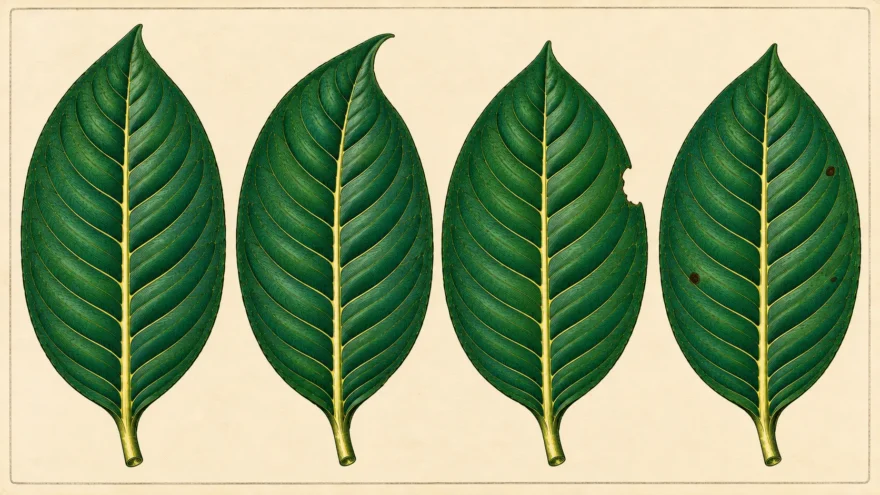
Thailand has three named kratom types that farmers and researchers use: Kan Daeng, Kan Khiao and Hang Kang. They look different. One shows a red midrib, one a green one. The third has a serrated leaf margin where the others are smooth. A 2026 study ran all three through eight genetic loci, including the regions used as standard plant barcodes. It found no genetic variation between them at any locus. All three shared one identical barcode. They formed a single group with no internal branching.
The same test worked perfectly well on the plant’s cousins. It separated Mitragyna speciosa from Mitragyna diversifolia, Mitragyna hirsuta and Mitragyna rotundifolia cleanly. In one region alone the gap ran to thirteen diagnostic positions. That’s the finding worth carrying. A test sensitive enough to catch an entirely different species couldn’t find any difference between the red one, the green one and the serrated one.
One thing did separate those three Thai types, and it wasn’t their genetics. The same study measured mitragynine in each, and the three did not carry the same amount. That was one sample of each type, and the larger studies, covering many trees, find no link between vein color and alkaloid content. So the plants were identical at every locus tested, and the amounts they carried were not. That is the shape of the whole problem. The difference is real, it is measurable, and the thing that measures it is a lab, not a label.
A second study, published two months later, came at it from the chemistry side. It took eight kratom accessions from central and southern Thailand. They differed visibly in leaf shape, in margin and in vein color. Seventeen alkaloids were measured in each. Those eight resolved into two genetic groups, not eight. And the leaf’s stage of growth mattered more to its alkaloid profile than which accession it came from. At maturity the profiles were largely consistent across all eight, despite the plants looking different.
Geography is the one place a real signal shows up. That second study reviews earlier work finding that Thai-origin and Malaysian-origin plants build measurably different alkaloid profiles. Region can matter. The trouble is that a name on a package isn’t evidence of a region.
What a strain name looks like from the sourcing end
We get two or three emails a week from growers, most of them out of West Kalimantan on the Indonesian side of Borneo.
Some of those emails list colors. Some list twenty or thirty strain names and ask which ones we want. The list is the offer. A grower asking a buyer which names to supply isn’t describing an orchard laid out in thirty blocks. He’s asking what sells.
The leaf behind those emails comes out of wild and semi-wild forest. Nothing stands between the tree and the package that could segregate one named variety from another, keep them apart through drying and milling, and carry a trace on each one. That infrastructure doesn’t exist, because nobody built it.
Run the arithmetic on a shop with thirty strain names on the shelf. Thirty names honestly sourced means thirty separately sourced lots, thirty chains of custody and thirty verifications. So look for the thirty lab reports, one per name, each with its own lot number. If a shop has thirty names and a handful of certificates, the names and the leaf aren’t tracking each other.
We’re not standing outside this. Maeng Da is what customers ask us for more than any other name, by a distance, and it’s why our own green and our own white carry it. We buy leaf we can verify and we put the name on it that people are looking for. Our white grew on Borneo, and White Borneo vs White Maeng Da holds the two names up against that one package. The honest version of that is telling you what the name is doing, which is what this page is.
There is a second reason to be careful, and it isn’t about naming. The barcoding study above notes that other Mitragyna species are marketed online as legal alternatives, with growing evidence of substitution in products sold as kratom. A name is not a check on what species is in the package. A barcode is, and so is a lab report, which is the subject of kratom lab testing.
So what does a strain name tell you?
It tells you what a seller chose to call one lot of leaf. That is not nothing, and it is not what most people think they’re buying.
That is useful information, as long as you read it as what it is. A vendor who applies a name consistently, to material bought from the same place, is giving you a handle for repeat purchase. The name is shorthand for their own sourcing. It just isn’t a chemical claim, a botanical claim or a claim about origin. It carries no guarantee that two packages with the same name came off the same trees.
What a name can’t do is stand in for a measurement. The alkaloid content of a lot is a number on a certificate. It moves with the tree, the season, the leaf’s age and the drying. That is covered in kratom alkaloids, and why it moves between lots is covered in kratom batch variation.
If you want to know where leaf came from, ask the vendor and see whether they can answer. That is one of the questions worth asking in choosing a kratom vendor. And if you want to know what region does to a plant, the geography itself is covered in where does kratom come from. Vein color names sit alongside all of this and are their own subject, covered in kratom colors.
Every name we could find on sale
Here is every name we could find on public retail listings, with the color words and the grade adjectives stripped off so only the names themselves are left. Sorted into what each one is actually doing.
Thirty of them are geography. Aceh, Bali, Banjar, Batak, Borneo, Bunut, Cambodia, Gayo, Hulu, Hulu Kapuas, Indo, Java, Jongkong, Kali, Kapuas, Ketapang, Kumai, Lombok, Mahakam, Malay, Nanga, Papua, Pontianak, Riau, Sulawesi, Sumatra, Sunda, Tamiang, Thai and Vietnam.
Two describe a leaf. Elephant, for unusually large ones. Horn, for a jagged margin.
Three describe processing rather than a plant at all. Bentuangie is a fermentation, done in sealed bags before drying. Chocolate is a longer version of the same idea. Black is a roast.
Eleven are marketing. Asia, Bota, Dragon, Hulk, Kraken, Maeng Da, Maha, Oasis, Pele, Trainwreck and Zenith. Maeng Da is sorted here for what it does on an American shelf. The word itself names a plant in Thailand, and whether the two are connected is a separate question, taken up on maeng da kratom. Trainwreck is openly a blend of several strains mixed together, which is worth sitting with. A blend is sold as a strain, on a shelf next to the strains it was blended from, and what a label should disclose about that is covered in what is a kratom blend.
Forty six names. Two of them describe the plant, three describe a process, eleven describe nothing, and thirty are places. That is what one pass through public listings turned up. There are more.
Now look at the thirty places. Eleven of them are the same island. Borneo is that island. Kali is short for Kalimantan, the Indonesian part of it, so that is the same place twice over. Kapuas is the longest river on Borneo. Hulu and Hulu Kapuas both point at the regency at its head, in West Kalimantan. Ketapang is another West Kalimantan regency. Pontianak is the provincial capital. Nanga is a town in Melawi Regency, also West Kalimantan. Banjar points at South Kalimantan, Kumai at Central Kalimantan, and Mahakam at a river in East Kalimantan.
Sold side by side, those eleven read as eleven origins. On a map they are one island, described at eleven different zoom levels, and six of them are one province.
None of which makes a name a lie. It makes a name a name. Read it as the label on one lot of leaf, ask for the report that goes with that lot, and the whole list gets a lot easier to walk.
Back to Kratom Basics or to the Kratom Guide.