
History of Kratom
Kratom’s history runs on two clocks. In Southeast Asia people have chewed and brewed the leaf for so long that the record doesn’t reach the beginning of it. In the United States the whole thing is recent. The tree entered European science in 1839. Its most abundant alkaloid got its name in 1921. American forensic laboratories logged their first sample in 2010.
Two things get lost in most versions of this story. Thailand banned the plant for 78 years, which is why the country most associated with the name supplied almost none of it. And the American market is younger than most of the people selling into it let on.
How far back does kratom use go?
Far enough back that the written record doesn’t reach the start of it.
In 1975 the United Nations published a study of kratom eaters in Thailand in its Bulletin on Narcotics. A physician at Srithunya Hospital in Nonthaburi wrote it. The study says the leaf had long been known there, and that the beginning of its use in Thailand can’t be dated. Fifty years on, that is the honest answer.
What the study does record is who. Sangun Suwanlert interviewed thirty people, twenty nine of them men, ranging in age from 31 to 77. Market gardeners, peasants and labourers were the common occupations. He drew them from Nonthaburi province and the suburbs of Bangkok. The leaf was chewed fresh. That is a portrait of an ordinary rural practice rather than of anything exotic.
The DEA’s fact sheet puts it at centuries, among people in Thailand, Malaysia, Myanmar and other parts of Southeast Asia.
When did Western science first record the plant?
In 1839, and the record is a Dutch colonial one.
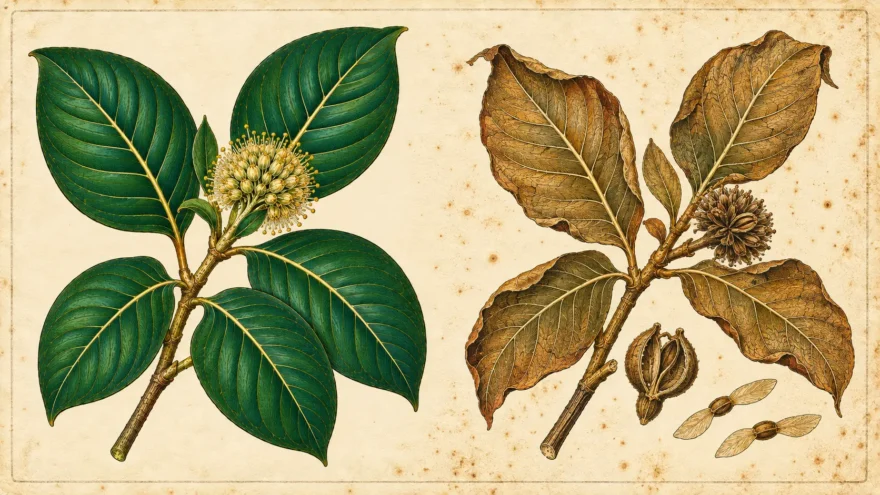
The International Plant Names Index records Mitragyna speciosa first appearing in print that year. It was published in Pieter Willem Korthals’ Observationes de Naucleis Indicis, in Bonn, with Borneo noted as the source. The described and illustrated version followed in the natural history of the Netherlands’ overseas possessions, on plate 35.
The genus name carries a piece of that history. Korthals called it Mitragyna because the stigmas of the flowers he examined looked to him like a bishop’s mitre. That account comes from E. J. Shellard of Chelsea College, University of London, writing in the UN’s Bulletin on Narcotics in 1974.
The chemistry came later, in pieces. Hooper isolated an alkaloid from the leaves in 1907. Field repeated the work in 1921 and named it mitragynine. Its structure wasn’t fully worked out until 1964, and 7-hydroxymitragynine, the other alkaloid every label mentions, wasn’t identified until 1993. By 1974 Shellard could publish a survey of the alkaloids across the whole genus. So mitragynine had a name for roughly a century before most Americans had heard the word kratom. The second of the two main alkaloids is younger than the internet. What those compounds are is covered in kratom alkaloids.
One line in Shellard’s paper is worth carrying. Citing work from 1965, he records that people where the tree grows distinguished between kratoms with red midribs and those with green ones. The four-color vocabulary on an American shelf is a later and looser thing, and it’s covered in kratom colors.
What happened in Thailand?
Thailand banned kratom in 1943 and kept the ban for 78 years.
The 1975 UN study names the instrument. The Kratom Act 2486 came into force on 3 August 1943. It forbade planting the tree, and existing trees were to be cut down. The plant was later listed as a Category 5 narcotic, which reached consumption, cultivation, trade and distribution together.
That ended in 2021. The Narcotics Act No. 8 was published in the Government Gazette on May 26, 2021. It took effect 90 days later, on August 24, 2021, and removed kratom from the narcotics list.
Between those two dates the country with the deepest documented tradition was legally out of the trade entirely. The consequence shows up on American packaging. A package labeled Thai names a country that wasn’t exporting for most of the period the word has been printed here. That’s covered in kratom strain names.
What did the rest of Southeast Asia do?
Three neighbouring countries took three different routes, and only one of them built an export industry.
Malaysia knows the leaf as ketum, and it has long been consumed in the northern peninsular states. Malaysia’s Ministry of Health records mitragynine as listed under the Poisons Act 1952 in 2003. It names the Pharmacy Enforcement Division as the enforcing body. The same paper notes that consumption carried on anyway, because the leaf had been consumed openly for generations.
Indonesia went the other way and made the plant a crop. On June 20, 2024, President Joko Widodo chaired a cabinet meeting on kratom cultivation, and the reason was a collapsed price. Agriculture Minister Andi Amran Sulaiman spoke afterwards. He said the price had fallen from about 30 dollars to between 2 and 5, and named quality and distribution among the causes. The government’s answer was to regulate cultivation and organize growers into cooperatives under one corporate structure. The reasoning was that an export market requires guaranteed quality and consistent supply, and that both would raise farmer incomes. Export regulations followed later that year.
The tree’s native range is wider than any of this. It runs across central and southern Thailand, northern Malaysia, Sumatra, Borneo, the Philippines and New Guinea. Where the trade concentrated was a policy outcome as much as a botanical one. The route the leaf takes is covered in where does kratom come from.
How did kratom reach the United States?
Late, and through the internet before anything else.
An international review published in 2015 traced online user reports back to 2001. It also records that by 2012, of the first hundred search results for the word kratom, 78 were sites selling it.
The forensic record starts later than that. DEA’s laboratory reporting system logged its first mitragynine report in 2010 and has received over 4,000 since. The annual count peaked at 609 in 2018, then fell year over year to 261 in 2024.
The consumption record grew alongside the forensic one. CDC reported 258 kratom-related exposure reports to US poison centers in 2015, and 3,434 in 2025. That is an increase of roughly 1,200 percent, across 14,449 reports over the eleven years. National survey data in the same report put lifetime use at 4 million people in 2019 and 5 million by 2023. Those are two different measures of the same thing, which is a market that got much larger very fast.
Federal action began in 2012, and it has been about imports, labeling and sale rather than about possession. That whole record sits on is kratom legal federally.
States moved first and they moved unevenly. Indiana’s ban took effect on March 15, 2012. Wisconsin’s followed on April 25, 2014, Arkansas’ on February 1, 2016 and Alabama’s on May 10, 2016. The opposite direction started in 2019, when Utah passed the first state law carrying the name Kratom Consumer Protection Act. What that model asks of a seller is covered in kratom consumer protection act.
Where else in the world has it traveled?
Far enough that the United Nations took a look, and far enough that European countries stopped agreeing with each other.
The World Health Organization’s Expert Committee on Drug Dependence met in Geneva from 11 to 15 October 2021. It carried out pre-reviews of kratom and its two main alkaloids. UNODC records the outcome. WHO recommended that kratom be kept under surveillance rather than taken forward to a critical review. Neither the plant nor its alkaloids appear in any schedule of the UN drug conventions.
Below that level the picture fragments. The European Union’s drugs agency profile records kratom as controlled in at least twelve of the countries it monitors. Denmark, France, Italy, Poland, Sweden and Turkey are among them. The profile names Australia, Malaysia, Myanmar and Thailand as controlling it under narcotic law, and New Zealand under medicines regulations. It places the United States outside that group, uncontrolled and listed as a drug of concern. There is no international consensus to appeal to here, and there never has been.
Europe also got the market’s first adulteration problem. That profile records two early problems. In the early 2000s, products labeled kratom acetate or mitragynine acetate turned out to hold no mitragynine at all. Later, products sold in Germany and Sweden as Krypton were found to carry caffeine and a synthetic pharmaceutical compound, added to the plant material. That’s worth knowing as history rather than as a scare. What was being sold under the word kratom stopped being only kratom very early.
Where it grows is a thinner story than where it sells. The agency profile describes the tree as native to Southeast Asia, the Philippines and New Guinea and now cultivated elsewhere, without saying where. It also says the dried leaf sold in shops and online is thought to come from Southeast Asia and most likely Indonesia. The DEA fact sheet notes that seeds and whole trees are sold by some online vendors. It reads that as raising the possibility of domestic cultivation here. University of Florida researchers have raised plants under glass for controlled trials. None of that adds up to a second supply.
What did the American market look like in 2020?
Small, and about to move in both directions at once.
We started Whole Earth Gifts in 2020. I hadn’t heard of kratom until shortly before that, when a friend’s wife explained it to me. With time on our hands during the shutdown, we built a company around it. There were a handful of vendors then. Some had been at it a long time, and a few of us were new.
The regulatory picture was thin in both directions. One state, Utah, had passed a law under the Kratom Consumer Protection Act name, in 2019. Four states had bans that can be read back to a dated instrument, and those were Indiana, Wisconsin, Arkansas and Alabama.
Then it moved quickly. Louisiana’s ban took effect on August 1, 2025. Connecticut’s followed on March 25, 2026, Kansas’ and Tennessee’s on July 1, 2026, and Massachusetts’ on August 28, 2026. In the middle of that run Rhode Island went the other way. It repealed its ban effective April 1, 2026, the first state ever to reverse one. Which states ban kratom, and under which instrument, is on is kratom legal.
Watching that from inside a shop, the thing worth saying plainly is that the direction reversed inside a single year. Anyone telling you the direction is fixed, either way, is guessing.
Does any of this change what’s in the package?
Not directly. It explains most of what’s printed on it.
The names come from a trade that grew up around a plant Western buyers met late and Southeast Asian growers have handled for centuries. The gap between those two clocks is where the vocabulary was invented. A leaf has a species, a growing region and a lab report. Everything else on the label was written by someone selling it, including us.
Back to Kratom Basics or to the Kratom Guide.