
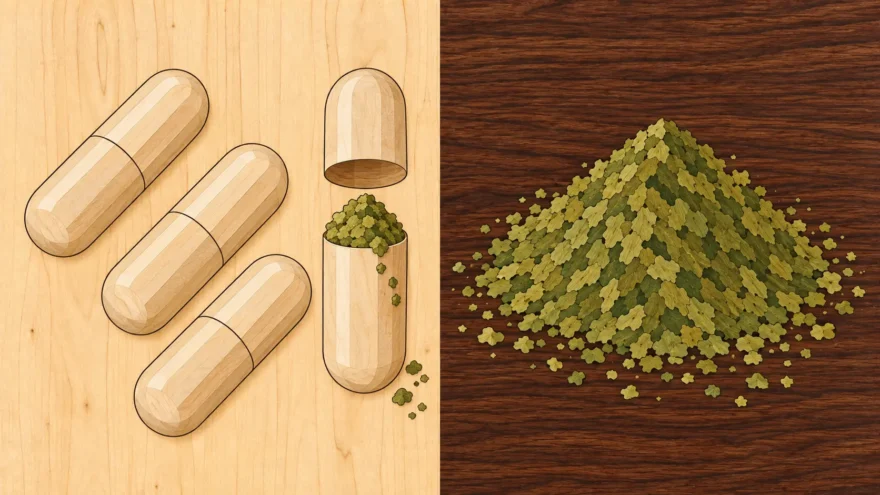
Kratom Capsules vs Powder
A kratom capsule is kratom powder in a gelatin shell. Same lot, same grind. The leaf does not change. What changes is the price per gram, who measures it, whether you taste it, and how well it travels. Most pages on this question open with two other things. How fast each one acts, and how much of it your body absorbs. Nobody has measured either one in kratom, and we will say so plainly further down. What we can tell you is what is in a bag of each, down to the shell. That includes the part where you get more than we charged you for.
Here is what makes this page different. We are publishing the arithmetic, not the conclusion. Go look at any other capsules against powder comparison and count the real numbers on it. You will find a price, a capsule count and a serving size. You will not find how much of the net weight is leaf and how much is gelatin. The moment a seller prints that, anyone can work out their true price per gram in about ten seconds. Ours is below, with the label figure and the real one side by side.
Is there any difference between kratom capsules and powder?
There’s no difference in the material. A capsule is a container. The thing inside it is the product.
Our capsules are filled from the same lots we bag as loose leaf, milled to the same 80 mesh. One ingredient, nothing else. Buy a bag of each on the same day and you have the same leaf twice. The rest of this page is about the container. What a mesh number means is covered on Kratom Powder. Ours sit at buy kratom powder and buy kratom capsules.
So this isn’t a choice between two products. It’s a choice about packaging, and packaging is what should decide it.
How much more do capsules cost?
Capsules cost more per gram of leaf than powder. The reason is mechanical rather than a markup on quality. You’re paying for the shells and for the machine time to fill them.
How much more depends on which number you count. The label figure and the real figure are different, and we will give you both.
First, why the gap is wider than the sticker price suggests. Federal labeling rules say the net quantity on the front of a package states what is in the package. Wrappers do not count. Other material packed in alongside does not count. A gelatin shell is neither of those. It is an ingredient, so it counts toward net weight. With loose powder the question never comes up, because the contents are leaf. With capsules the contents are leaf plus several hundred shells.
So here’s our spec in full, including the parts that work against us.
We label our capsules at half a gram of leaf each. Four capsules to a two gram serving, and the servings per container follow from that. The number we measured is an average of 532 milligrams. We round it down to 500 on purpose. Fill weight moves with the density of the leaf, and density moves by color. An average printed as a promise would leave some colors short of it. Rounding down turns half a gram into a floor that every color clears. We label the capsule counts the same way. Then we run the bags a little over on top of that. Three buffers, all pointing the same direction.
An empty size 00 gelatin shell weighs about 125 to 130 milligrams on our scale. Add that to the measured 532 and a filled capsule comes to about 660 milligrams. Roughly 80 percent of that is leaf and 20 percent is shell.
Now run it both ways. The label on a quarter kilo bag promises 350 capsules at half a gram. That is 175 grams of leaf, and it is what we charge against. Take the same bag at 660 milligrams a capsule and the net weight works out closer to 380 capsules, holding about 200 grams of leaf. That’s before the overfill.
One column below does not move. Powder’s label and its real figure are the same number, because the contents are leaf and nothing else. For capsules they are two different numbers, and that gap is what this whole page is about.
| Bag size | Powder label and actual | Capsules label | Capsules actual |
|---|---|---|---|
| Quarter kilo | 250 g of leaf $29 11.6 cents a gram | 175 g of leaf $39 22.3 cents a gram | About 200 g of leaf $39 19.5 cents a gram |
| Half kilo | 500 g of leaf $49 9.8 cents a gram | 350 g of leaf $59 16.9 cents a gram | About 400 g of leaf $59 14.8 cents a gram |
| One kilo | 1,000 g of leaf $79 7.9 cents a gram | 700 g of leaf $99 14.1 cents a gram | About 800 g of leaf $99 12.4 cents a gram |
Against the label, capsules run 72 to 92 percent more per gram of leaf. Against what’s in the bag, 51 to 68 percent. The first pair is the honest answer to what we sold you. The second is what you’ll pour out. Count a bag and you should find more than we promised, not fewer. If you ever find fewer, we want to hear about it.
The tool on how much does kratom cost runs the same arithmetic against any brand and size we carry. It uses our label figures rather than our measured ones. That understates us, and it is the right way around. A comparison engine should hold us to what we printed. What a capsule count on a weight filled bag can and cannot tell you is covered on Kratom Capsules.
Who decides how much you take?
You do, both ways. The difference is that with powder you measure it yourself. With capsules a machine measured first and handed you the result in fixed pieces.
That’s the real trade between the formats, and it matters more than the price. Loose powder gives you every amount a scale can read. That’s the most control any format offers, and the most responsibility. A capsule hands you a unit somebody else set. Our panel prints four capsules to a two gram serving. That’s a statement about the package, not a recommendation.
Nothing about a capsule takes the decision away from you. You can take fewer or more. You can pull one apart and use part of it, and plenty of people do. What the capsule changes is the default. With powder, every amount is a fresh decision you have to make and measure. With capsules, the easy path is a whole number of units, and splitting one is enough trouble that most people don’t bother. Whether that helps you or gets in your way is a question about you.
Do kratom capsules take longer than powder?
Nobody has published a measurement. Every page handing you a number is inventing it.
We went looking before we wrote this. There’s no published study comparing kratom in a capsule against the same leaf taken loose. Not in the clinical literature, not in the pharmacokinetic literature, not in the trial registries, not in any government record. What turns up instead is a pair of ranges, repeated almost word for word across unrelated sites. About ten to twenty minutes for powder. About thirty to forty five for capsules. No source is ever attached. The identical figures appear on pages that share nothing else. That’s folklore copied until it looks like data.
What’s actually true is narrower. A gelatin shell has to open before anything can leave it. That’s a real property of gelatin, and a real reason to keep capsules cool and dry. It’s covered on Kratom Capsules, along with what goes wrong with a shell that has been stored badly. Past that, anyone telling you how the two formats compare inside a person is describing something nobody has looked at.
We would rather write that sentence than fill the space with a number we made up.
What is each one like to live with?
Powder asks for a scale, a glass and a rinse. Capsules ask for a glass of water.
Kratom leaf is bitter, and with powder you taste it. That one fact is why most people who switch to capsules switch. Powder also means a little cleanup, a counter that shows every spill, and a scale you have to own. In exchange it’s cheaper per gram, and it goes into anything you can stir. The routes it opens up are their own subject, on how to take kratom.
Capsules travel better, which counts for more than it sounds like it should. A sealed bag of capsules is easier to carry than a pouch of powder and a scale. Nothing in it can spill. What to know before you pack either one is on traveling with kratom.
One thing runs the other way. In a capsule bag the shell ages before the leaf does. Capsules carry a storage requirement that loose powder does not.
Which one should you buy?
Buy powder if price per gram is what matters, or if you want to set your own amount. Buy capsules if you would rather not taste it, measure it or carry a scale. That’s the whole decision. It’s about your kitchen, not about kratom.
The format does not decide quality either way. What decides it is whether there is a current lab report on the lot in your hand, and whether you can read it. That’s covered on kratom lab testing.
Here’s the thing worth taking away. Ask any seller what fraction of their capsule bag’s net weight is gelatin. Then ask what their measured fill weight is against the number they printed. They will either have both numbers or they will have never asked their filler. We would rather publish that about a fifth of ours is shell, and that we label 500 milligrams while measuring an average of 532, than let you work it out on your own.
Back to Kratom Comparisons or to the Kratom Guide.