
What Is Kratom Powder?
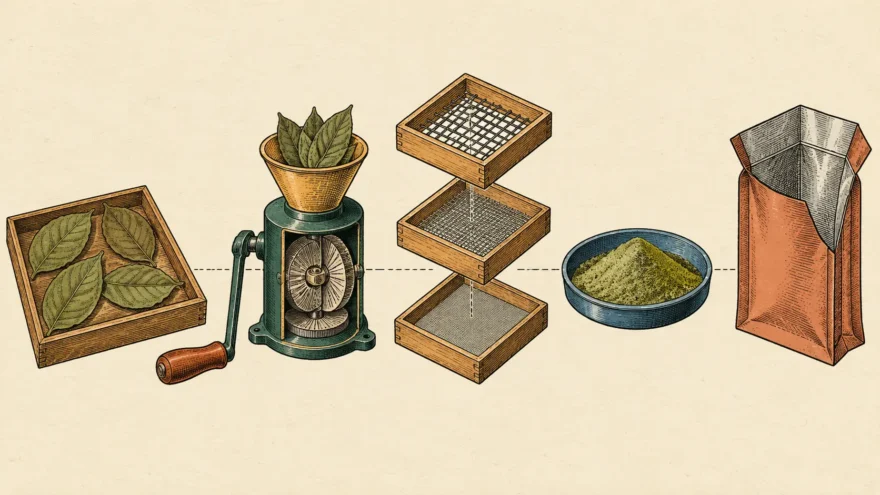
Kratom powder is dried kratom leaf milled to a fine grind. It’s the base material for nearly everything else on a kratom shelf. Capsules are powder in a shell. Tablets are powder pressed into a shape. Extracts start as leaf too. What separates one powder from another is where the leaf grew and how finely it was milled. The figure that describes the milling is a mesh number, and it’s the least understood number in the category. Most bags do not print it at all. Here’s what it measures, why an American kratom powder cannot be coarse, whether a finer grind changes what is in the bag, and what we buy to.
What is in a bag of kratom powder?
Kratom powder is the dried leaf of Mitragyna speciosa, milled fine and sifted. The stem and the thick central rib come out before milling. One ingredient, nothing added. Nearly every other kratom format is built out of it, which makes it the first format worth understanding. How a leaf on a branch becomes a sealed pouch is covered on what is kratom. This page picks up at the mill. Our own milled leaf sits at buy kratom powder.
There is a coarser product too. Crushed leaf, called crumb in the trade, is leaf broken down but not taken all the way to powder. It handles differently and it’s a small corner of the American market.
What does a mesh number measure?
A mesh number counts the openings in one inch of a sieve. A higher number means a finer powder. The number describes the screen, not the particle, and the thickness of the wire changes how wide each opening ends up. That’s why standards bodies name a sieve by the width of its opening in micrometers, which are thousandths of a millimeter. The mesh count is an approximate label. On the US standard series, an 80 mesh screen opens to about 180 micrometers. The trade calls 40 to 50 mesh coarse, 60 to 70 fine, and 80 and above very fine.
Almost no kratom bag prints a mesh number, and that is not a plot. A mesh number is a purchasing spec rather than a label field, so it lives in the paperwork between a seller and a mill. The way to get it is to ask, and a seller who cannot answer has not set one.
The United States Pharmacopeia sorts powders another way, and the gap between the two methods is where labels go soft. Its current scale sorts by the median particle. Half the material sits below that figure and half above it. A median between 125 and 180 micrometers is fine. At or below 125 micrometers it’s very fine. So a mesh number is a ceiling and a pharmacopeia grade is a middle. Those are two different claims about the same bag. A label reading fine tells you which word a seller picked. It doesn’t tell you what anyone measured.
Why can’t an American kratom powder be coarse?
Indonesia will not let coarse kratom leave the country, and nearly all American kratom is Indonesian. Permendag 20 of 2024 bans the export of whole kratom leaf outright. It bans cut, crushed or milled leaf coarser than 600 micrometers as well. Permendag 21 of 2024 sets the terms for what may go. Cut, crushed or milled leaf at 600 micrometers or finer may be exported, under a registered exporter, an export approval and a surveyor report. Both took force on October 11, 2024.
Six hundred micrometers is roughly a 30 mesh screen, and 30 mesh is coarse. So there’s a floor under every kratom powder on the American market, whether the seller knows about it or not. A floor is not a standard. It rules out the roughest material. It says nothing about the difference between a 40 mesh powder and an 80 mesh one, and that’s the range the market actually sells in.
One line in that rule is worth reading twice. An export approval is worked out from the milling capacity a company declares, times an export right percentage the ministry sets each period. Indonesia meters its kratom trade by how much grinding a company can do. The mill is not a step in the supply chain there. It is the unit of account.
Does a finer grind change what is in the powder?
No published evidence says that milling kratom finer changes how much alkaloid the material holds. Alkaloids are the family of compounds a laboratory measures in kratom leaf, and mitragynine is the most abundant one. A 2025 Thai study measured mitragynine across vein types and growing regions with a validated laboratory method. Its leaf powders ran from about 78 to 112 micrometers in mean particle size, a narrow band at the fine end. The authors put the differences they found down to where the leaf grew and which part of the plant it came from, not to the small gaps in grind.
Two limits travel with that. The study compared fine against fine. It never put a coarse grind up against a fine one, so it does not settle the wider question. And it measured extraction into a solvent in a laboratory, which is not what happens in a kitchen.
What milling cannot do is add anything. How much alkaloid a leaf holds is decided by the tree, the season and the drying shed, long before the leaf reaches a mill. A finer grind is a finer version of whatever arrived.
What does the grind actually change?
The grind changes how a powder handles rather than what it contains. A very fine powder clumps the moment it meets water and has to be worked in. It leaves a finer sediment behind. It fills a capsule the same way each time, because small particles pack into a shell more tightly than large flakes do. And it carries less of the fibrous material a coarse milling leaves in.
How a powder gets taken is its own subject with its own page, and the methods live on how to take kratom. A fine powder also exposes more surface to air than a coarse one. That’s a storage question rather than a milling one, and it is covered on does kratom expire.
What can you tell by looking at a powder?
The look of a powder reports how the leaf was dried and handled, not what is inside it. Milled kratom leaf is green and stays green. A deep brown-red cast over that green comes from a particular drying regime. Where the color names came from is covered on kratom colors. Texture tells you about the mill. Powder that feels gritty between the fingers came off a coarser screen. Powder that feels like cocoa came off a fine one.
What looking cannot tell you is the part that matters most. Alkaloid content, heavy metals and bacteria are all invisible in a bag of green powder. The one thing that reports them is a certificate of analysis, the document a laboratory issues for a single batch. Reading one is covered on kratom lab testing.
What do we buy to, and what happens to a lot before it reaches us?
We buy to 80 mesh, roughly 180 micrometers, which puts our lots at the fine end of what the trade sells. The milling happens at origin. So the number is a purchasing decision rather than something that happens on our side.
Milling in West Kalimantan runs in two passes. The first produces crumb. The second takes crumb down to fine powder. Field research from Universitas Tanjungpura records that most Indonesian demand at home is for crumb, so the second pass is largely an export step. The fine powder an American customer pictures when they hear the word kratom is, at origin, the version made for people overseas.
Every lot is given a gamma pass before export, at 6 kilograys, at a commercial facility near Jakarta. For scale, the FDA ceiling for putting dried culinary herbs and spices through the same process is 30 kilograys. The microbial sample is drawn after the gamma pass rather than before it. That order is the whole point, and it is the part most often done backwards. A microbial number taken beforehand describes material that no longer exists by the time anyone reads the report.
One thing we will not claim. No published study has measured what a gamma pass does to kratom’s alkaloids. Work on other dried botanicals at similar levels generally finds the main compounds unchanged. Nobody has run it on this leaf. Until somebody does, that’s an open question rather than a reassurance, and we’d rather say so than round it off.
A lot is tested three times before anyone can buy it, by three separate parties. The first test happens at origin. Mitragynine content is measured in Indonesia before export, and the microbial panel is run there after the gamma pass at an accredited Indonesian laboratory. The second is our supplier’s, run once the material lands in the United States, and those are the supplier’s reports rather than ours. The third and final one is ours, at our own accredited laboratory in Texas, on the material as it arrived. Those last reports are the ones we publish.
Back to Kratom Forms or to the Kratom Guide.