
Blate Papes Review
In 1902, in a small town in Mie Prefecture, Japan, a man named Masataro Kobayashi was experimenting with starch and agar when some of the mix spilled onto a hot iron kettle. The water cooked off. What was left behind was a thin, clear film. He saw something in that mess, and within a few years, the world was buying it.
More than a century later, two people in the United States turned that same idea into a brand called Blate Papes. It is not a kratom brand. It is an edible film brand, and we’ve carried it since 2021. We’re grateful for the film, and just as grateful for the two people behind it. So this page is our thank you.

Who is behind Blate Papes?
A company called Blated, and the two people who started it, Hannah Barrett and Harrison Cohen.
Hannah and Harrison met in 2016 and officially launched Blate Papes in June 2020. That’s the same month Whole Earth Gifts opened its doors, which we think makes us something like birthday twins. The company used to go by BlateCo before it renamed itself Blated. It’s based in Austin, Texas, so it’s a Texas company too.
How did Blate Papes get started?
In a kitchen, with a problem most people would have given up on.
By their own telling, Hannah and Harrison were buying plain, single ingredients in bulk and mixing their own powders at home. The taste was terrible. They tried wrapping the powder in thin paper. It was a neat trick with real problems. Most paper is not made to be eaten, and it was scratchy and tore easily. So they went looking for something better, and they landed on edible film.
That is the whole founding story in one line: two people who couldn’t stand the taste and refused to put up with it.
What’s in the name?
Half Japanese, half shorthand.
Blate comes from oburāto, the Japanese word for this kind of thin starch film. Pape is short for paper. Put them together and you get a name that sounds a little like a joke and is actually a history lesson.
What is a Blate Pape, exactly?
A very thin sheet of dried gel, made from potato starch.
It looks like paper, but it is not. It is a gel that has been dried flat. When it touches water, it softens back into a gel. Blated calls it a single ingredient product, and the ingredient is potato starch.
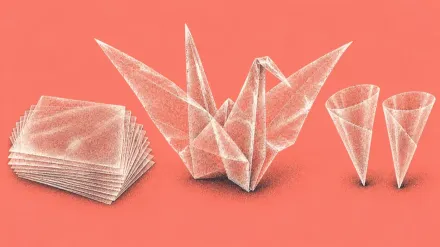
The film comes in two shapes. There are flat square sheets, and there are small pouches rolled into a cone, a bit like a tiny funnel. Blated says the film is made in Japan, in an FDA registered facility certified to ISO 22000. ISO 22000 is an international standard for how a food maker manages safety from start to finish.
So the film is made in the country where it began.
Where did edible film come from?
From that kettle in Mie Prefecture.
Stiff wafers made their way into Japan from Europe in the late 1800s. They were imported and expensive. Kobayashi’s film was different. It was soft, clear and thin. He patented it in Japan, Britain, the United States, Germany and France. It won a bronze medal at the 1904 World’s Fair in St. Louis and a gold medal at the 1910 Japan British Exhibition in London.
By 1910, his factory was turning out about 700,000 packs a year, each holding 100 to 200 sheets. It employed 97 workers, most of them women. In 1913 he built an automatic steam machine to make far more. The film also found a second job in Japan, as a wrapper for candy. Mie Prefecture’s own history office names Kobayashi as one of the three great industrialists of modern Mie, right beside Kokichi Mikimoto, the man behind cultured pearls.
The kettle survives. Kobayashi’s family donated it to a museum in his hometown, now called Tamaki.
There’s a story told in Japan about visitors from overseas who were handed a jelly candy wrapped in this film. They tried to peel it off, sure it was plastic. It took some convincing that the wrapper was meant to be eaten. We love that story.
How did we find Blate Papes?
By happy accident.
In the summer of 2021, we were looking around for something else when we came across Blate Papes. We thought of kratom right away. Kratom powder has a famously strong, bitter taste, and here was a film made to wrap powder. So we reached out.
Hannah and Harrison were excited from the first email. They sent samples, answered every question we had and helped us get the products set up in our store. We added them shortly after. Blated’s own website now lists kratom among the most popular uses for its film.
We carry both shapes, the squares and the pouches, and they are the stars of the show. We also carry the digital scale Blated sells. It reads down to a hundredth of a gram and holds up to 500 grams. How to Take Kratom explains why weighing powder beats scooping it, and Kratom Capsules vs Powder compares the two most common forms.
What’s it like to work with Blate Papes?
A pleasure, every time.
We have never met Hannah and Harrison in person. It has always been email and phone. That hasn’t mattered one bit. They answer fast, they’ve offered us any marketing material we could need, and they bring a positive attitude to every conversation. The only thing they ever seemed to care about, beyond the film itself, was that people use their products responsibly. We respect that a lot.
Every Blate Papes product we carry is on our Blate Papes page.
Thank you, Blate Papes
A spill on a hot kettle in 1902. A film that won medals on two continents. Two people who hated a bad taste enough to build a company around fixing it, in the same month we opened our own doors. And one email in the summer of 2021 that brought their film to a kratom shelf.
So thank you, Blate Papes. And thank you, Hannah and Harrison, for being wonderful to work with, for backing us from day one and for bringing an old Japanese idea to Texas.
Back to Kratom Brand Reviews or to the Kratom Guide.