
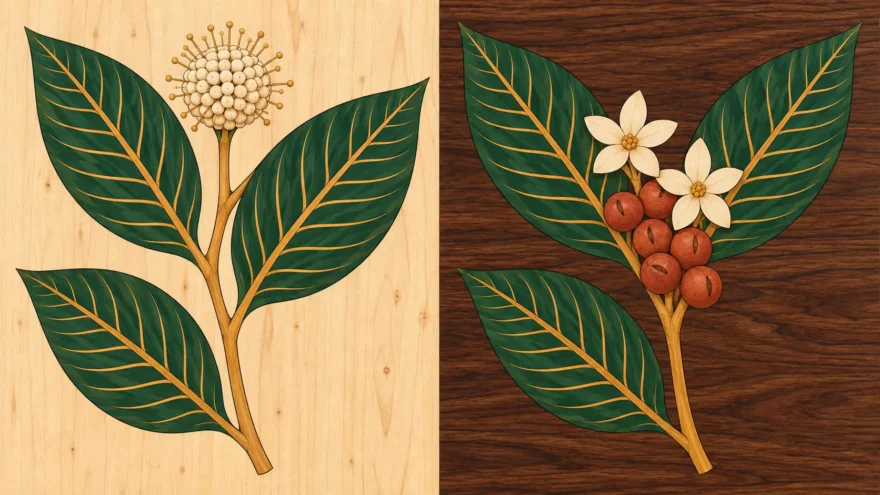
Kratom and Coffee
Kratom and coffee are cousins. Both belong to the Rubiaceae family, one of the largest families of flowering plants. That is where the resemblance mostly ends. Kratom is sold as a leaf and coffee as a seed, and one genetic estimate puts the split between their family lines at about 47.6 million years ago. What they share is written in the way their leaves grow on the stem, and in one compound found in both.
Here’s what this page adds. It shows what actually makes the two plants family, and it isn’t the round flower head kratom is known for. It explains why coffee leaves are sold as a food too, legally, in Europe. And it answers why a compound tied to coffee turns up in kratom leaf.
Are kratom and coffee related?
Yes, as distant cousins in a very large family.
The Flora of China, a standing botanical reference published online by the Missouri Botanical Garden and Harvard University Herbaria, counts about 660 genera and 11,150 species in Rubiaceae. It names coffee, quinine and madder among the family’s important economic plants. Kratom, Mitragyna speciosa, belongs to the same family.
Family is a wide word here. A 2022 genome study of kratom from Thailand compared its DNA with two coffee species, Coffea arabica and Coffea canephora. It estimated that kratom’s line and coffee’s line split about 47.6 million years ago. That is a long way back. They are relatives, but not close ones.
What do kratom and coffee plants have in common?
Their leaves grow in pairs, with a small flap between the stalks.
Both plants set their leaves opposite each other, two at a time. Both also grow stipules, small leafy flaps at the base of each leaf pair. In this family the stipules sit between the two leaf stalks rather than beside each one, and the Flora lists that arrangement in its description of the family. On kratom the stipules are large and pressed together over the growing bud, and they fall early. On coffee they stay on, joined briefly around the stem.
The flowers are where the two part ways. Kratom packs its flowers into round, ball-shaped heads. The ball is the most striking thing about the tree in flower, but it isn’t what makes kratom a member of the family. Coffee carries its flowers in small clusters where the leaves meet the stem.
The fruit differs as well. Kratom sets a small dry capsule full of tiny flat seeds, each with a short wing at both ends. Coffee sets a fleshy fruit, red, yellow or darker, that usually holds two seeds. Each seed has a groove down its flat face. That seed is the coffee bean.
Why does kratom use the leaf and coffee the seed?
Each trade grew up around a different part, but coffee leaves are used too.
Kratom is leaf and nothing else. It is picked, dried and milled, and that powder is the base of every kratom product we sell, from capsules to extract. The whole range is at buy kratom online.
Coffee is known for the seed, which is roasted before it’s brewed. Its leaves are a food as well. In 2020 the European Commission authorized an infusion of coffee leaves as a traditional food from outside the European Union. The company that applied showed a history of use in Africa, Asia and North America. The Commission set upper limits for caffeine and for chlorogenic acid in the finished drink, which tells you coffee leaves carry both.
So a leaf steeped in hot water is something the two plants have in common after all. Kratom leaf has long been brewed that way, and How to Make Kratom Tea covers how it works.
Do kratom and coffee share any compounds?
At least one, and it is not a family secret.
A 2025 laboratory analysis of freshly picked kratom leaves found chlorogenic acid in extracts made from them. Kratom Extract vs Powder covers what else that analysis turned up. Chlorogenic acid is so closely tied to coffee that it is also called coffee tannic acid. Green coffee beans hold a lot of it, and roasting lowers the amount.
It would be easy to read that as a family trait. It isn’t. A 2022 review describes chlorogenic acid as widely found in flowering plants and in ferns. Apples, potatoes, tomatoes and eggplant all carry it. It’s common across the plant world, so finding it in both says little about how closely they’re related.
The compounds each plant is known for are different. Coffee is known for caffeine. Kratom leaf is measured by mitragynine, the most abundant of its alkaloids. Kratom Alkaloids covers what’s in the leaf.
Can you take kratom with coffee?
Nobody has studied the combination in a controlled way.
A PubMed search on 09/18/26 found no controlled study of kratom taken with coffee or caffeine. It did find one case report, published in 2024 in the European Heart Journal. An 18-year-old man collapsed during football training with a dangerous heart rhythm. His blood tested positive for kratom and caffeine. Heart imaging didn’t show a cause, and his doctors suspected the combination with hard exercise. They also wrote that the evidence linking kratom to that rhythm isn’t enough. One case can’t show a cause. It is a reason not to assume the pairing is harmless.
Combining kratom with any other substance raises the stakes, and kratom and alcohol explains why. We don’t sell coffee.
Kratom and coffee came from one family and went separate ways a very long time ago. They share a leaf arrangement, a mark on the stem and a common plant compound. What’s in your cup or your bag is a separate question, and the label and the lab report are where it gets answered.
Back to Kratom Comparisons or to the Kratom Guide.