
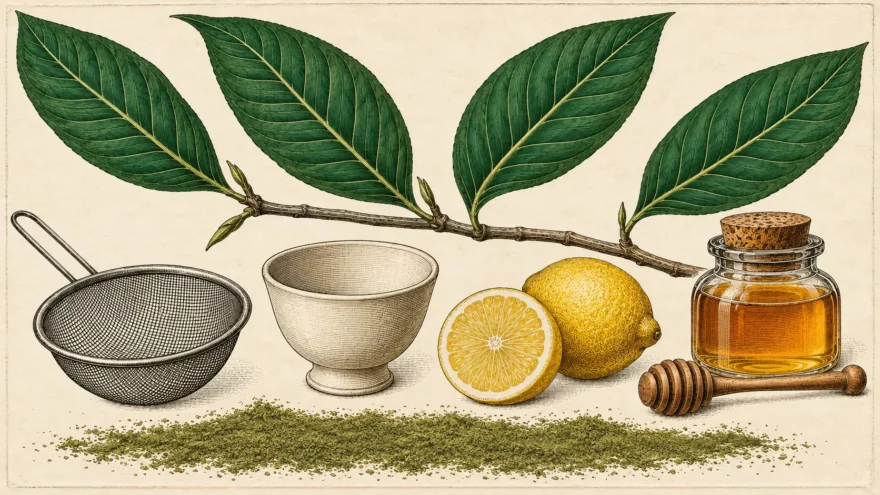
How to Make Kratom Tea
Kratom tea is kratom leaf steeped in hot water and then strained. That’s the whole method. The water, the time, and whether you strain at the end are the only parts that change the result. Most brewing advice online is confident and unsourced, and two claims come up again and again. One says hot water ruins kratom. The other says a squeeze of lemon makes a stronger cup. Both have been measured in a laboratory, and the measurements don’t say what the advice says. Here is what the published work shows, what it leaves out, and the places where we won’t guess.
What is kratom tea?
Kratom tea is a water extraction, which is a plain way of saying that water pulls some of the leaf’s contents out and you drink the water.
Brewed tea is the older way of taking kratom. In Southeast Asia, where the tree grows, the leaf has been chewed fresh or boiled into a drink for as long as anyone has recorded it. Powder in a capsule is the newer arrangement, and it’s mostly an American one. The ways people take kratom that don’t involve brewing are on how to take kratom.
Does hot water destroy kratom’s alkaloids?
No, not at the temperatures a tea reaches, as long as the water isn’t extreme at either end.
Alkaloids are the family of compounds a laboratory measures in kratom leaf, and mitragynine is the one there’s most of. What they are and why the numbers move is covered on kratom alkaloids.
Forensic scientists at Sam Houston State University tested this question directly, with funding from the National Institute of Justice. They put five kratom alkaloids in water at five acidity levels and five temperatures, then measured them ten times across eight hours. The full report is published by the Office of Justice Programs.
One number in that study needs explaining. pH is a scale for how acidic or how alkaline a liquid is. Lower is more acidic, and lemon juice sits near that end. Plain water sits in the middle. Higher is alkaline, like water with baking soda stirred in. A cup of kratom tea sits in the mildly acidic part of the scale.
| Water | Heat | Loss at 8 hours |
|---|---|---|
| Tea range | 176 F | None |
| Tea range | 140 F | None to 7% |
| Very acidic | 140 F | 47% |
| Very acidic | 176 F | All of it |
| Alkaline | 176 F | 25% to 31% |
Read the first two rows again. At the acidity a cup of tea actually has, nothing was lost, and that held at the hottest temperature tested. Heat by itself is not the problem. Heat paired with a sharp extreme is.
Three limits travel with that finding and they belong right beside it. The work was done on purified alkaloids in a laboratory buffer, not on leaf in a pot. The hottest temperature tested was 176 degrees Fahrenheit, which is below boiling. And the window was eight hours.
What about actually boiling it?
Boiling doesn’t wipe it out, and there’s a study that shows it in passing.
A team at the Ramathibodi Poison Center in Bangkok needed kratom tea for a study in people. They cut 40 grams of fresh leaf into 2 liters of water and boiled it. They compared a thirty minute boil against a full hour and chose the hour. The finished tea carried measurable mitragynine, which is how they were able to run the study at all.
That is not a controlled test of boiling and we won’t describe it as one. Nobody has run the eight hour stability test at 212 degrees. What it does establish is that an hour of hard boiling leaves a usable amount behind.
Why does straining matter, and what does it leave behind?
Straining is what separates tea from swallowing powder, and it leaves more behind than most people expect.
The reason is that water is a poor solvent for mitragynine. Researchers at Universiti Sains Malaysia measured it directly. In plain water, about 65 micrograms of mitragynine will dissolve per milliliter. That’s a small figure, and it’s the whole story of why a strained cup and a mouthful of powder are not the same thing.
So when you pour the liquid off and throw the leaf away, part of what was in the bag goes into the bin. That is not a flaw in the method. It is what the method is.
We hear the practical side of that from customers, and it’s worth saying plainly because most brewing guides skip it. People who strain tell us they go through product faster than they expected. Some have moved to kratom capsules for that reason alone, which is a cost decision rather than a preference about taste. The laboratory number and the phone calls are describing the same thing from two ends.
If you’d rather not leave anything behind, don’t strain. Plenty of people stir the powder into warm water with honey and drink the whole thing, sediment and all. Honey dissolves completely, so what it covers is the bitterness rather than the texture. The grit is a separate problem and it stays.
The other route people describe to us is straining anyway and then adding honey, which gives you a cup with no grit in it and a little sweetness. There is no right answer in that set. It is a texture and a cost question, and people land in different places on it.
What does adding lemon actually do?
It dissolves more of the leaf into the water. It does not break anything down into something stronger.
Mitragynine is what chemists call a base. In acidic water, part of it converts into a form that water accepts more easily. The same Malaysian team measured that too. In plain water, about 65 micrograms dissolved per milliliter. In an acidic buffer, 3.5 milligrams did.
Now the conditions, because they matter more than the figures. That was a laboratory buffer held at body temperature for two full days, until nothing more would dissolve. It was not a mug, it was not a squeeze of lemon, and it was not ten minutes.
The same acidity also has a ceiling working against it. Look back at the table. In strongly acidic water at 176 degrees, mitragynine’s half life was forty eight minutes, and all of it was gone inside six hours. The condition that dissolves more of it is the same condition that destroys it once heat is added. More acidic and hotter and longer is not a ladder that keeps climbing.
One thing we won’t claim. A number of pages state that citrus breaks alkaloids down and makes a stronger preparation. We went looking for the study behind that. There isn’t one. No published research has measured an ordinary cup of kratom tea made with citrus against the same cup made without it. What exists is a solubility measurement in a laboratory buffer, and a solubility measurement is not a statement about a person. Every page we found asserting otherwise was a seller’s blog with nothing underneath it.
What about honey, sugar, ginger and cinnamon?
Those are taste, and nothing else.
Kratom tea is bitter and grassy. Sweeteners and spices make it easier to drink. We have seen no research suggesting any of them changes the chemistry, and we are not going to imply that they do because they happen to sit in the same mug as something that does.
Can you brew a batch and keep it?
Yes, sealed and refrigerated, and there’s a study behind that answer too.
The Bangkok team kept their brewed tea in sealed bottles in a refrigerator and tested it across fourteen days. The alkaloid held. That was a laboratory refrigerator and sterile bottles rather than a pitcher on a shelf, so read it as the outside edge rather than a promise about your kitchen.
Dry leaf is a separate question with a separate answer, and how it changes over months is on does kratom expire.
Which kratom suits brewing?
Powder works, and it’s what nearly every American kratom drinker brews with. Ours is at buy kratom powder.
Fine powder clumps the moment it hits water and has to be stirred in, then it sinks. That’s the trade you make for a fine grind, and why the grind matters is on kratom powder.
There’s a coarser product called crushed leaf, sometimes sold as crumb, and it is the traditional brewing material. It strains more cleanly because the pieces are larger. Whole Earth Gifts doesn’t carry it and never has. It’s described on kratom forms for anyone who wants to know what it is.
The method, start to finish
Seven steps, and the only one anybody argues about is the last.
- Put your kratom powder in a pan with water.
- Bring it to a simmer and hold it there. The Bangkok team boiled theirs for a full hour after testing thirty minutes against sixty.
- Stir now and then. Powder settles and packs down if you leave it alone.
- Take it off the heat and let it sit for a few minutes.
- Pour it through a coffee filter, a cheesecloth, or a fine mesh strainer into your mug.
- Add lemon, honey or spices if you want them, for taste.
- Refrigerate anything you don’t drink, sealed.
Back to Kratom Basics or to the Kratom Guide.