
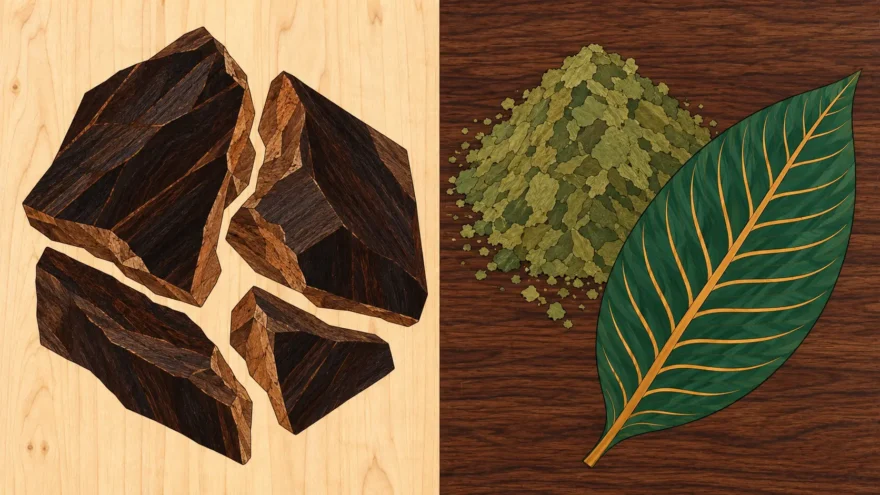
Kratom Extract vs Powder
Powder is leaf made smaller. Extract is leaf with most of itself taken away. A gram of powder is a gram of leaf, fiber and all. That makes powder the only kratom format where the unit on the label and the material in the bag are the same thing. A gram of extract is what survived from several grams of leaf. A solvent pulled out whatever would dissolve, and a filter discarded whatever would not. Same tree, same leaf, two different materials. The most common mistake in this category is reading them as two strengths of one thing.
Here’s what this page adds. Nearly everyone comparing these two writes about how much stronger an extract is. Almost nobody asks what the rest of an extract actually is. The honest answer is that a good part of it has never been identified.
What is the real difference between kratom extract and powder?
One is a smaller version of the leaf. The other is a different material made from it.
Milling changes the size of a particle and nothing else. Whatever the leaf carried, the powder carries, in the same proportions. Nothing left. That is why a gram is a gram. What a mesh number measures and how milling gets there is on Kratom Powder.
Extraction is subtraction. Soak, filter, cook down. What remains is a fraction of what went in. Fiber does not dissolve, so it leaves with the filter, and fiber was most of the weight. How that process runs, step by step, is on Kratom Extract.
So the difference is not a dial. You do not reach extract by turning powder up. You reach it by discarding most of the leaf and keeping the part that dissolved.
What is in an extract that is not kratom alkaloid?
Most of it, and some of it has no name yet.
Start with the yield figures on Kratom Extract and run them backward. The laboratory batch behind those numbers turned about five grams of leaf into one gram of dried extract. Mitragynine came back at a single-digit percentage of that gram. Now invert it. More than nine tenths of an extract powder is not mitragynine.
So what is it? An LCMS/MS analysis published in Natural Product Research in 2025 went looking. The work came out of Universiti Sains Malaysia and Yale. It found the leaf’s other alkaloids, which is no surprise, since a solvent that dissolves one will dissolve its relatives. It also found four plant phenolics carried through untouched. Chlorogenic acid, o-coumaric acid, quercitrin and rutin. None of those is an alkaloid. All of them dissolved, so all of them stayed. Chlorogenic acid is the compound coffee is best known for after caffeine. That’s less of a coincidence than it sounds, and kratom and coffee explains why.
Then the part worth sitting with. The same analysis reported compounds in the chromatograms and mass spectra that it could not identify. The authors wrote plainly that establishing the full spectrum of what is in this plant needs further work. That’s a peer-reviewed paper saying there are things in here nobody has named.
Here’s the fair objection, and it deserves an answer. Leaf powder is mostly not alkaloid either. Published figures put mitragynine in dried leaf in the low single digits of a percent. So powder is overwhelmingly something else too. That’s true. The difference is what the something else is. In powder it is leaf. Fiber, cell wall, the whole plant in the proportions it grew in. In an extract it’s a selection, made by a solvent, of whichever compounds happened to dissolve. Nobody chose that list. Nobody has finished naming it.
Now set that beside a tablet. An extract tablet is also mostly not kratom. What the rest of it is appears on the back of the package, because a manufacturer chose every one of those ingredients and has to declare them. Kratom Extract Tablets covers what each one does and why a press cannot run without them.
That comparison is the cleanest way to hold the whole subject. A tablet’s non-kratom fraction is declared, because somebody added it. An extract’s non-alkaloid fraction is not declared, because nobody added it. It came along. And it is nearly all of the material in your hand.
None of that makes an extract dangerous by itself. It makes it less characterized than leaf. That’s a narrower claim, and a more useful one.
Can you convert between them?
Not honestly, and the reason sits upstream of the extract.
Any conversion has to start from how much alkaloid the leaf held. The published figures for that do not agree. Two 2026 papers land in ranges that barely overlap. Kratom Extract lays out the disagreement and where each number comes from.
Once the baseline is unsettled, every figure built on it inherits the wobble. A multiplier printed on a package describes what went into a pot, not what sits in the container. The leaf that went into that pot varies by season and by lot. Two products can both be honestly labeled and land a factor of ten apart.
A gram of powder needs no conversion, because it is a gram of leaf. That’s the whole advantage, and it’s worth more than it sounds.
Where does extract powder actually end up?
In nearly everything in the category except the plain leaf shelf.
Once the concentrate is dried and milled, that powder becomes the raw material for the rest. It gets filled into extract capsules and pressed into tablets. It gets dissolved into the liquids sold in small bottles, blended into drink mixes and canned drinks, and cooked into gummies, candies, taffies and honeys. When you see kratom in a confection, this is what’s in it. The formats look nothing alike. The material inside them came off the same pan.
That list includes one trap worth naming. An extract capsule and a leaf capsule are the same object from the outside. Same shell, same size, same shelf. What’s inside them isn’t the same material at all. The only thing that tells you which is which is the label.
Sold loose in a bag, that extract powder is the one form we won’t carry. Kratom Extract gives the reasoning in full. The short version is that it resembles leaf powder closely enough to be measured like leaf powder. Every other format on that list has a portion built in. A capsule holds what a capsule holds. A gummy is a gummy. Loose extract powder is the only one where the customer does the measuring.
We cover it because you can buy it from another seller without leaving your chair, and a store that explains only its own shelf isn’t running an education program.
Which one should you buy?
If you’re new to kratom, leaf powder, and it isn’t close. Extracts are not a starting point, and nothing on this page should be read as an argument that they are. Ours are at buy kratom powder.
If you already know the leaf and you’re weighing a concentrate, the useful question isn’t how many times stronger it claims to be. Ask three things instead. What does the package state in milligrams, per serving and per container. Did a laboratory confirm that number, and can you read the report. And what is the rest of the product, given that the rest is most of it. Ours are at buy kratom extract.
A seller who can answer all three has done the work. A seller who answers with a multiplier has told you about a pot you will never see.
Back to Kratom Comparisons or to the Kratom Guide.