
What Is Kratom Extract?
Kratom extract is kratom leaf with the bulk taken out. Powder is leaf milled small, so a gram of powder is a gram of leaf. Extract is leaf soaked in a liquid, strained, and cooked down, so a gram of extract is what survives from several grams of leaf. Same tree, same leaf, a different material in the container. The word describes a process, not a strength, and that is the most useful thing to understand about the whole category. Here’s how an extract gets made, how much of the leaf ends up in one, what the numbers on the label are worth, and how to tell a real extract from something wearing the word.
What is in a kratom extract?
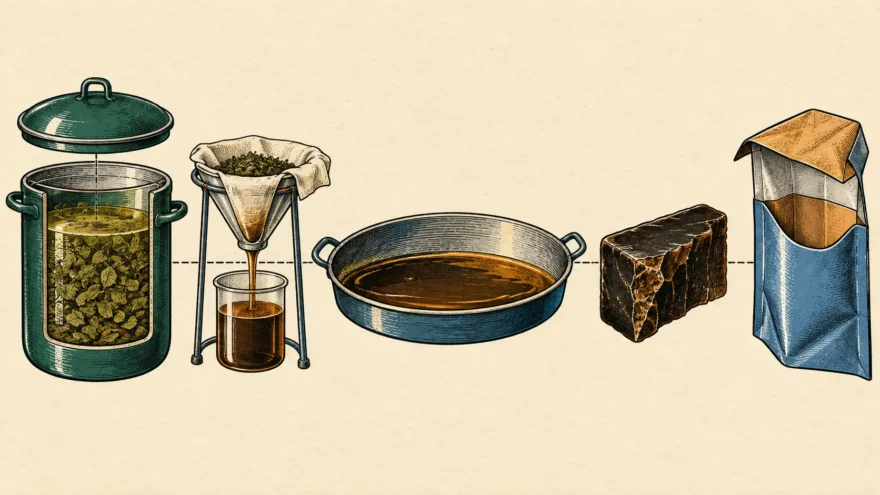
An extract starts as milled leaf. A solvent goes in, usually water or food grade ethanol or a mixture of the two. The solvent dissolves the alkaloids and the other soluble parts of the leaf. The spent leaf is filtered out and discarded. The liquid is cooked down until the solvent is gone, and what stays behind is the extract.
What leaves is most of the plant. Fiber and cellulose do not dissolve, so they go out with the filter. What remains is a much smaller amount of material holding most of what the leaf’s alkaloids amounted to.
That’s the whole definition, and it carries a consequence that comes back later on this page. Extraction is subtraction. It takes the bulk away and it can’t add or create anything, so the alkaloids in an extract should be the same alkaloids the leaf had, in roughly the same proportions, in a smaller package.
Our extracts are at buy kratom extract and the leaf they start from is at Kratom Powder. Extracts are not where a new customer should begin, and the last section of this page says why.
How is an extract actually made?
Four steps, and they do not change with the size of the operation.
The leaf soaks. Water does the job, food grade ethanol does it better on alkaloids, and most producers use a mixture of the two. Some acidify the water, because kratom’s alkaloids dissolve more readily in acid.
The liquid gets separated from the spent leaf, through a filter or a press.
The solvent is driven off with heat, low pressure, or both, until what is left is thick.
Then it becomes a product, and that last step is where the formats come from.
Two things follow. The solvent has to come back out, which makes residual solvent a fair question to ask about any extract rather than a technicality. And nothing in that sequence can put an alkaloid into a leaf that did not have one.
How much of the leaf ends up in an extract?
Start with the leaf, because every extract figure is measured against it. Here’s the honest position. The published numbers do not agree with each other.
Two peer reviewed papers from 2026 put total alkaloid content in kratom leaf at 0.5 to 3 percent of its weight and at 2 to 5 percent of its weight. Mitragynine is the largest single share of that, reported at 51 to 82 percent of the total alkaloids in one and 40 to 66 percent in the other. By weight, one paper puts mitragynine in leaf under 1 percent and rarely above 2.5 percent, and the other puts it at up to 2 percent.
Take that disagreement seriously, because it is the foundation everything else on an extract label rests on. If the baseline is unsettled, every claim expressed as a multiple of it inherits the same wobble.
The direction is not in doubt. One of those papers reports that extracts can hold five to fifty times the alkaloid content of the native leaf. Five to fifty is the problem with the word in one line. Two products can both be labeled extract, both honestly, and sit a factor of ten apart, and nothing on the front of either package tells you which one is in your hand.
A laboratory run shows the arithmetic. A 2025 Thai study soaked milled leaf in ethanol and got back about 18 to 20 percent of the starting weight as dried extract, with mitragynine at roughly 4.6 to 8.0 percent of that extract. So five grams of leaf became about one gram of extract, and that gram carried several times the share of mitragynine the leaf did. Two limits travel with those figures. Every sample was Thai, and the authors say plainly the results should not be stretched to Indonesian leaf. And a controlled laboratory extraction is not a production line.
What do the numbers on an extract label mean?
Three conventions are in circulation and only one of them is a measurement.
The multiplier is the oldest and the emptiest. A label reading 10x or 50x is meant to say how many parts of leaf went into one part of extract. No standard sets how it is calculated and nobody checks it. Taken at face value it cannot tell you what is in the bottle anyway, because the leaf it started from varies. Fifty times a thin lot and ten times a rich one can land in the same place.
Here’s the cleanest way to hold it. A multiplier describes the input. A percentage describes the output. Only one of those is in the container.
Leaf equivalence is a step better. Some labels, including the liquid extracts we carry, state a bottle as equivalent to a quantity of raw leaf. The 30ml MD25 bottle is stated as equivalent to 25 grams of leaf. That names an amount rather than a ratio, which is harder to fudge, and it depends on whose leaf.
Alkaloid content is the only one a laboratory can confirm. Milligrams of mitragynine per serving, and the share of the extract that is mitragynine, are figures somebody measured. The Zion Herbals Lucky 80 package states 80mg of mitragynine per tablet at 80 percent concentration. That’s what the package states rather than a number we’ve verified, and it’s the shape of number worth looking for.
Regulators have picked a side on this. Rhode Island’s Kratom Act took effect on April 1, 2026, and the state’s labeling guidance required product labels to carry mitragynine, 7-hydroxymitragynine and total alkaloids in milligrams, per serving and per product. No multiplier appears anywhere in it.
What are the different types of kratom extract?
Here’s the part most guides get backward. These are not separate products. They are one material in different packages.
The concentrated extract comes off the pan as a thick resin, and most of it is then dried and milled into a loose powder. That powder is the raw material. It is what gets filled into capsules, what gets pressed into tablets, and what gets blended into anything premixed. Every format below starts there.
Extract powder, sold loose in a bag exactly as it comes off the mill. It is the plainest form and the one we will not carry, and the next section is why.
Liquid extracts, sold by the bottle in small volumes, usually 12ml or 30ml. Concentrate dissolved into a carrier. This is the largest part of the category and it has its own page at liquid kratom extract.
Extract tablets, pressed into a fixed shape. Pressing needs binders, something to help the tablet break apart again, and something to make the powder flow, so a tablet is a blend rather than concentrate alone. That’s at kratom extract tablets.
Extract capsules, the same powder inside a shell. These are not the leaf capsules on the rest of the shelf, which hold milled leaf and nothing else. From the outside the two are identical. What’s inside is not, and Kratom Capsules covers the leaf version.
Drink mixes and premixed drinks, where the powder is blended into a flavored base and sold either as a dry mix or already in a can or a bottle.
Edible candies, gummies, taffies and honeys, where the same powder goes into a confection.
Resin, the oldest form of all, kept as the solid it started as and sold in a block. It is rare in American retail.
Why is extract powder the one to watch?
Because it’s the form with nothing around it, and because a bag of it looks like a bag of kratom powder. It tends to run tan rather than green and it’s a little lighter in the hand. That’s the whole visible difference.
The trap is the spoon. Somebody who measures leaf powder by the scoop measures extract powder the same way, out of habit, and what ends up in the cup bears no relationship to what they meant to take. The texture gives no warning. The color gives a hint that’s easy to explain away. The weight gives nothing at all, because a lighter bag reads as a finer grind.
Every other format on the list above has a portion built in. A capsule holds what a capsule holds. A tablet is a tablet and a bottle is a bottle. Loose extract powder is the one form where the customer does the measuring, which is exactly why we don’t stock it and have no plans to.
It gets a section here anyway, because a reader can buy it somewhere else this afternoon, and a store that explains only what it sells is not running an education program.
Is everything sold as kratom extract actually an extract?
No, and this is where the category has changed fastest.
A 2026 study in the Journal of AOAC International bought five brands of tablets, all labeled as containing kratom extract, and ran them against authentic leaf on a validated method. Mitragynine came back at 2.0 to 6.0 milligrams per gram, which is low. 7-hydroxymitragynine, which occurs in leaf only in traces, came back at 22 to 75 milligrams per gram. The leaf’s other major alkaloids were absent. Peaks appeared that do not occur in leaf at all. The authors concluded the products were not kratom extracts as labeled.
That’s a finding about identity rather than about anybody’s experience, and it hands you a test. Extraction is subtraction, so an extract of leaf should read like leaf on a laboratory report, only concentrated. The same alkaloids, in roughly the same proportions. When the proportions are wrong, something was added or something was manufactured, whatever the front of the box says.
The labeling problem is wider than one study. The University of Florida College of Pharmacy bought 44 kratom products online and in stores across several states and reported in July 2026 that measured composition failed to match the label in 85 percent of them. Two qualifications travel with that figure. It measured which alkaloids were present and in what amount, not whether a strain name was accurate, because no test can verify a strain name. And the sample was tablets, films, liquid shots and edibles, things that are manufactured rather than milled, not plain leaf powder. That’s exactly why the figure belongs on this page and not on the powder page.
One point of vocabulary is worth setting straight here, because the two meanings get used as though they were one. 7-hydroxymitragynine is a naturally occurring alkaloid that the leaf carries in traces. 7-OH, on a label and on a shelf, names a class of concentrated product built around that compound at levels the leaf never reaches. We’ve never sold 7-OH products and we don’t defend them. What is on this site is leaf, and extracts made from leaf.
Why is our extract selection so short?
Because we chose it, and the reasoning is worth saying out loud.
We’ve tried the category. Candies, taffies, honeys, flavored shots. Our customers didn’t want them. The people who buy from us lean toward the plain end of the shelf, and our extracts are natural extracts that happen to be concentrated. We’ve never carried 7-OH in any form, because it sits too far from what this business is.
We also don’t get asked. Requests for extracts we do not stock have not arrived in any volume worth acting on, and if they start arriving we’ll act on them. The lineup grows when demand shows up rather than ahead of it. The effort until now has gone into the education program rather than into the extract shelf.
One thing worth knowing comes from unpacking them. Extract tablets come out tan. Every tablet we have ever carried, from every maker, has been tan, which is odd when you follow the chain backward, because the leaf’s green and the concentrated resin is a brown so dark it reads as black. A tablet is neither color because a tablet is a blend, and the pressing ingredients are part of what you are looking at. The liquids look like what they are, dark and resinous, and they don’t taste good. The extract capsules are a deep green and look more like a leaf capsule than anything else in the category, which is the same confusion problem in a smaller package.
Every extract lot on our shelf has a certificate of analysis and we hold it.
What should you check before buying kratom extract?
Read the milligrams and ignore the multiplier. Milligrams of mitragynine per serving is a measurement. A number with an x after it is a marketing convention with nothing behind it.
Ask for the certificate of analysis on the lot and read it, rather than trusting that it exists. What one covers and how to read it is at kratom lab testing.
Look at the whole alkaloid profile on that report and not only the headline figure. An extract of leaf carries the leaf’s other alkaloids alongside mitragynine. One that doesn’t is a different product wearing the same word.
Ask how it should be stored, especially with liquids. Shelf life and storage have their own page at does kratom expire.
And extracts are not where a new customer starts. The plain leaf formats are a known quantity with a long record behind them, and there’s no reason to begin at the concentrated end of the shelf. If you want the two set side by side, that’s at kratom extract vs powder.
Back to Kratom Forms or to the Kratom Guide.