
What Are Kratom Extract Tablets?
A kratom extract tablet is concentrated kratom pressed into a fixed shape, along with a few other ingredients that make pressing possible. The shape is the point. A tablet is portioned before you buy it. There is nothing to weigh and nothing to mix.
What surprises most people is how little of the tablet is kratom. Both extract tablets we carry weigh one gram. In both of them, the extract is a small fraction of that gram. The rest is what holds the tablet together.
Here’s what’s in one, how pressing works, what the other ingredients do, what the numbers on the package mean, and what the lab reports say about the two brands sitting side by side on the same shelf.
What is actually in an extract tablet?
Mostly not extract.
The Zion Herbals Lucky 80 panel states 100 milligrams of kratom extract in a one gram tablet. The KR8OM panel states 85 milligrams in a one gram tablet. So about 90 percent of the tablet in your hand is something other than kratom.
That’s not a defect and it is not a trick. You cannot press 85 milligrams of anything into an object a person can pick up and split. A tablet needs bulk to exist at all. Ours are at buy kratom extract tablets.
This is the one thing a tablet does that a capsule does not. Kratom extract capsules hold the same powder loose inside a shell, with nothing added and nothing pressed. A tablet has to become a solid object, so the blend is part of the product.
The blend is also what you are looking at. Extract tablets come out tan, from every maker we have ever carried, which is odd when the leaf is green and the concentrate is nearly black. The Kratom Extract page explains why.
The material that goes into the press is extract powder, which is concentrate that has been dried and milled. That page also covers how the concentrate is made. This page is about what happens to it next.
How is a tablet pressed?
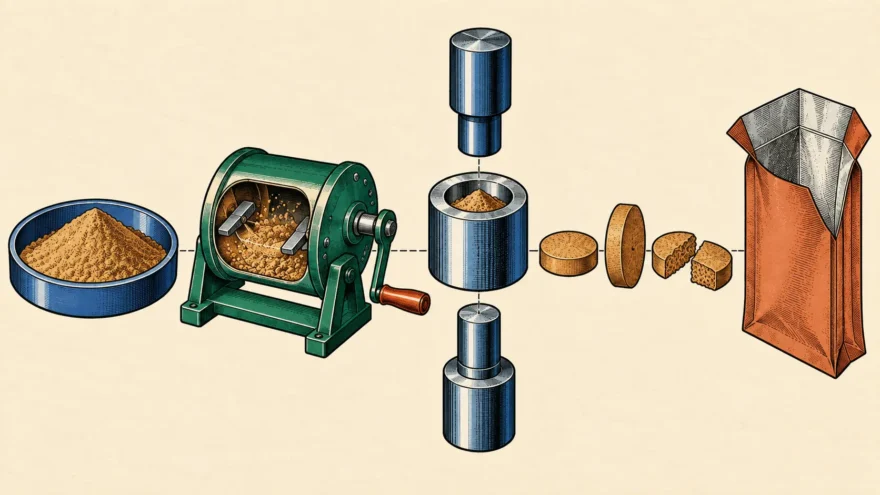
A tablet press is simpler than it sounds. Powder falls into a hole in a steel plate called a die. A punch comes down from above and another holds from below. The two squeeze the powder until the particles lock together. Then the lower punch rises and pushes the tablet out.
The powder has three jobs. It has to do all three, every time, thousands of times an hour.
It has to flow. The same amount of powder must drop into the die on every stroke, because whatever lands in that hole is what the tablet weighs.
It has to bind. Under pressure the particles have to grip each other. Packing together loosely is not enough, because the tablet falls apart on the way out.
It has to let go. The tablet has to release from the steel rather than sticking to the punch.
Extract powder on its own does none of the three well. It’s a small amount of sticky material that pulls water out of the air. A die filled with it would produce a smear. That is why a tablet is a blend rather than concentrate alone, and it’s why the ingredient list matters more here than on any other format.
What do the other ingredients do?
Both packages list the same three. Sucrose, silicified microcrystalline cellulose, and stearic acid. Two different companies, in two different states, reached for the same three materials.
The FDA’s food rules have a name for this class. Formulation aids, defined in 21 CFR 170.3, are substances used to produce a physical state or texture in a food. The rule names carriers, binders, fillers and tableting aids. Release agents are a separate class in the same rule. They keep ingredients and finished products from sticking to the surfaces they touch.
Sucrose is sugar. It provides bulk. In a tablet built around a bitter concentrate, the sweetness is not an accident either.
Silicified microcrystalline cellulose is two materials processed together as one. Microcrystalline cellulose is plant fiber broken down with acid into a porous crystal. Under pressure that porous structure folds rather than shattering, which is what a binder has to do. The silicified part is a small amount of silica processed in with it. The cellulose folds under pressure and the silica does not, and pairing the two is what makes the blend press well.
There’s a small irony in that. Making an extract means filtering the leaf’s own fiber out and throwing it away. Pressing that extract into a tablet means putting fiber back in, from a different plant.
Stearic acid is the release agent. It’s a fatty acid found in animal fats and in vegetable oils. The FDA’s listing says it is made commercially either from hydrolyzed tallow or from hydrolyzed, fully hydrogenated vegetable oil. Both routes are ordinary. Neither package says which one is in the tablet.
If animal derived ingredients matter to you, that’s a fair question to ask the manufacturer. It is the same question a capsule shell raises, and Kratom Capsules covers that side of it.
What do the numbers on a tablet package mean?
Two numbers, and they’re not the same number.
Extract per tablet is how much concentrate went into the press. Mitragynine per tablet is how much of the leaf’s main alkaloid that concentrate carries. Divide the second by the first and you get the strength of the extract itself.
| Product | Tablet weight | Extract per tablet | Mitragynine per tablet | Tablets per pack |
|---|---|---|---|---|
| Lucky 80 | 1 g | 100 mg | 80 mg | 10 |
| KR8OM | 1 g | 85 mg | 25 mg | 12 |
Run the division. 80 into 100 is an 80 percent extract, which is where the Lucky 80 name comes from. 25 into 85 is about 30 percent, which is what the KR8OM panel prints.
Now read the mitragynine column again. Two tablets, the same category, the same shelf, the same one gram shape. One holds more than three times the mitragynine of the other. Nothing about the word tablet tells you that. Neither does the size, because the size is identical.
That’s the thing to carry away from this page. With powder, the amount is decided by how much you scoop. With a tablet, the amount was decided at the factory, and the only place it is written down is the panel on the back.
What do the lab reports say?
Every extract lot we carry is tested by an independent third party laboratory, and we publish the report. The report belongs to the manufacturer rather than to us. We hold it, we read it, and we put it where a customer can read it too, on our lab tests page.
| Alkaloid | Lucky 80 per tablet | KR8OM per tablet |
|---|---|---|
| Mitragynine | 85.76 mg | 21.08 mg |
| Speciociliatine | Not detected | 7.06 mg |
| Paynantheine | Below the limit | 3.68 mg |
| Speciogynine | Not detected | 2.61 mg |
| Total major alkaloids | 85.76 mg | 34.43 mg |
Read down each column rather than across, because the columns describe two different kinds of product.
The KR8OM report reads like leaf. Mitragynine is about 61 percent of the measured total, which sits inside the published whole leaf ranges of 40 to 66 percent and 51 to 82 percent. The other three alkaloids line up underneath it in the order leaf puts them in. That’s the test the Kratom Extract page hands you. An extract of leaf should read like leaf on a report, only concentrated. This one does.
The Lucky 80 report reads like one alkaloid. Mitragynine is the entire measured total. The other three were either not detected or sat below what the instrument can measure.
Neither of those is a labeling failure, and this part is worth reading twice. The KR8OM box says broad spectrum, and the report shows a broad spectrum. The Lucky 80 box says high purity and 80 percent. A highly purified extract is one where the other compounds have been taken out. Both packages describe what the lab found.
They are two different things wearing the same three words on the front. The certificate is the only place a customer can see that.
One warning about reading a certificate, and it applies to all of them. Check what unit the per serving column uses before you compare it to the package. On these two reports a serving is one tablet, which is easy. On the Liquid Kratom Extract reports the lab’s serving is one milliliter while the package’s serving is six. A reader comparing straight across would decide the label was inflated six times over, and the label is accurate. Kratom lab testing walks through a full report end to end.
What does the score on a tablet promise?
Both tablets are scored, and the Lucky 80 panel tells you to split one in half for a half serving.
A score is a pressed line across the face of a tablet. It suggests the tablet will break there, into portions that match. Whether it does is a testable question, and the FDA has published what that test looks like.
A 2013 guidance on scored tablets sets out what a maker should show before a score gets called functional. Split the tablets by hand and with a splitter. Weigh fifteen tablets against their own pieces and confirm that less than three percent of the mass is lost. Run the pieces through the standard tumble test that checks for chipping. Confirm the pieces meet the same finished product requirements the whole tablet meets. Show that a piece holds up after 90 days at 77 degrees Fahrenheit and 60 percent humidity. The agency’s stated concern is that splitting can move the content, the weight and the breakup behavior of what is left.
That guidance is written for drug applications, and it is advice rather than law. No kratom product is held to it. So a pressed line on a kratom tablet is a suggestion until somebody checks it.
What we can tell you is what comes out of the boxes. Both tablets we carry break on their lines into halves and quarters without crumbling. We’ve never had one arrive chipped, soft or stuck together. We’ve never had a tablet order come back at all. These have been among our best selling extract products since the day we put them on the shelf.
How are tablet packs sold?
Small, and that is worth thinking about.
Both brands come as blister cards inside a box. Lucky 80 is 10 tablets, and the box front states 800 milligrams of mitragynine for the pack. KR8OM is 12 one gram tablets. Neither box is bigger than a deck of cards.
Both panels state a serving as one tablet. The Lucky 80 panel also prints a limit of two tablets in 24 hours, right on the back.
The hazard is the one the liquid bottles have, in a different container. A small pack that fits in a pocket reads as a single unit, the way a small bottle reads as a single drink. It is not one. It is ten or twelve portions with the dividing lines already drawn.
The blister is the format’s real advantage, and it’s why a tablet is the hardest extract format to lose track of. A bag of powder has no boundary in it anywhere. A blister card has a boundary between every tablet, and pushing out a second one is a decision a person has to make on purpose.
Why do kratom packages not all look the same?
Because nothing makes them.
Pick up either tablet box and you will find a Supplement Facts panel on the back. Pick up a bag of our own leaf powder and you will find a Nutrition Facts panel instead. Those are two different labeling formats with two different sets of rules behind them, and the same plant is inside all three packages.
That’s nobody’s mistake. As our own page on federal law lays out, no federal rule says how a kratom product has to be tested, what has to appear on the label, or what is allowed in the package. Companies pick a format and follow it, and sensible companies pick differently.
It’s also the reason this page spends so long on panels and reports. Where there’s no standard, reading carefully is the only tool a customer has. Is Kratom Legal Federally? carries the full record.
Why tablets are not where a new customer should start
Because a tablet is concentrated, and a new customer has no reference point for what that means.
The plain leaf formats are the known quantity, with the long record behind them. Kratom Powder and Kratom Capsules are both ordinary milled leaf. There is no reason to begin at the concentrated end of the shelf. If you want the two set directly against each other, that’s at kratom extract vs powder.
What should you check before buying kratom extract tablets?
Read both numbers, not one. Extract per tablet and mitragynine per tablet are different figures, and only the second one describes the leaf’s main alkaloid.
Compare brands on milligrams rather than on the word extract. Two one gram tablets can be three times apart.
Read the other ingredients. A tablet has them by necessity, and a list you cannot identify is a fair thing to ask about.
Ask for the certificate of analysis on the lot. Read the whole alkaloid profile rather than the headline figure, then check what unit its serving column uses.
Count the tablets and work out the cost per tablet. A ten pack and a twelve pack at similar prices are not similar purchases.
Keep them sealed and away from heat and light. Shelf life and storage have their own page at does kratom expire.
And extracts are not where a new customer starts. That holds for tablets exactly as it holds for everything else in this category.
Back to Kratom Forms or to the Kratom Guide.