
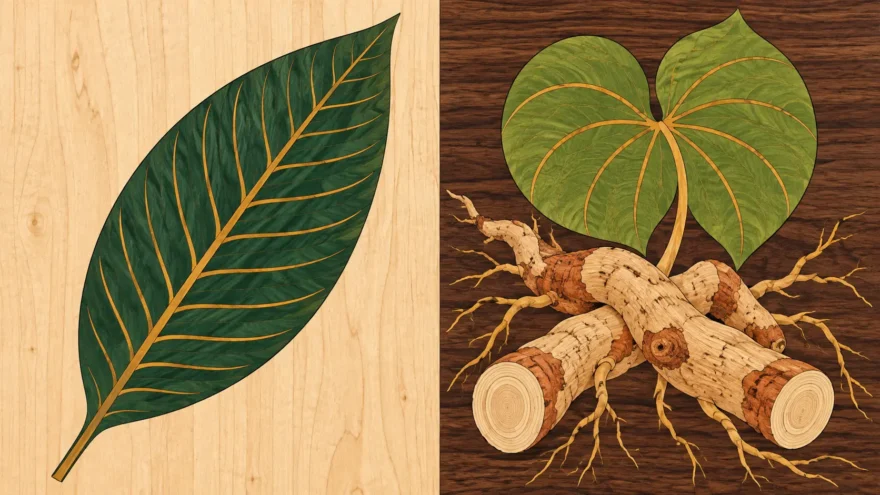
Kratom vs Kava
Kratom is a leaf. Kava is a root. Kratom comes from a tree in the coffee family that grows in Southeast Asia. Kava comes from a shrub in the pepper family that grows on the islands of the Pacific. The two plants aren’t related, and they don’t grow in the same part of the world. People don’t use the same part of each plant, either. The clearest way to see the gap is the international food standard written for kava. It excludes the leaf. Kratom is nothing but leaf.
Here’s what this page adds. It sets out what kava’s own standard keeps out of the bowl, and why. Then it reports what a 2026 lab study found inside small drinks sold as kava in Alabama. That second part matters to anyone who buys either plant.
What is the difference between kratom and kava?
They’re two unrelated plants from different parts of the world, and people use a different part of each.
Kratom is Mitragyna speciosa. It is an evergreen tree in the Rubiaceae family, the same family as coffee. It grows wild across much of Southeast Asia and reaches roughly 13 to 52 feet. Only the leaf is used. It is picked, dried and milled into the green powder behind nearly every kratom product. What Is Kratom covers the plant in full. Every kratom product we sell starts as that leaf, from powder to capsules to extract, and the whole range is at buy kratom online.
Kava is Piper methysticum. It is a shrub in the Piperaceae family, the family black pepper belongs to. Hawaii’s Department of Health describes it as four to eight feet tall, with a root that grows three to five inches thick. A 2026 paper in the Proceedings of the National Academy of Sciences places its origin in northern Vanuatu, about 3,000 years ago.
The same paper explains how kava spreads. Cultivated kava can’t reproduce from seed. The plants people grow are sterile clones, selected long ago from a wild relative, Piper wichmannii. The authors write that it spreads only by human effort, from stem cuttings.
Why does kava’s standard leave out the leaf?
Because the compounds kava is prized for sit in the root. The leaf and stem carry others.
The standard comes from the Codex Alimentarius Commission, which two United Nations agencies set up to write food standards. In 2020 it adopted a regional standard for kava products for North America and the South West Pacific. It allows peeled rhizome, the base of the stem up to its first node, and roots. It excludes upper stems, leaves, peelings and bark. Only noble varieties qualify, and wild kava and the two-day varieties are named as excluded. No additives are allowed. The label has to name the part of the plant and the country it came from. Its preparation steps are meant to open with an instruction to use drinking water.
The reasons are chemical. An FDA scientific memo from 2020 reports that kava’s main compounds, called kavalactones, are concentrated in the rhizome and roots. They run highest in the side roots and taper off toward the top of the plant. A 2016 review for the same two agencies, the Food and Agriculture Organization and the World Health Organization, adds the other half. Kava’s alkaloids, one of them called pipermethystine, turn up mostly in the stem and leaves. Those are the parts exposed to sunlight, and traditionally they were peeled away. The review found a case for keeping stem peelings and leaves out of kava altogether.
Kratom runs the other way. The leaf is the whole product. In kratom’s case it’s the stem that gets stripped out, because it mills poorly and adds bulk without adding alkaloid. What the leaf holds is covered in kratom alkaloids.
One more difference matters before you compare two labels. Kavalactones aren’t alkaloids. A kratom lab report is read in mitragynine, the leaf’s main alkaloid. A kava product is judged on its total kavalactones. The two reports measure different families of compounds, so no number on one lines up with a number on the other.
How is each one traditionally prepared?
Kava is a drink made with water. Kratom leaf has been chewed and brewed.
The 2016 review describes the ceremonial method. Fresh or dried root is crushed or pounded and mixed with water or coconut milk. It is worked by hand, then strained through cloth or bark into a shared bowl. The review records kava drinking in Pacific ceremonies for more than 2,000 years. In Hawaii the root was once chewed before it was steeped, and pounding later took over.
The water matters. The same review reports that ethanol or acetone pulls two to ten times as much kavalactone out of the root as water does. Solvent extracts sold as pills and liquids were behind the liver injury cases reported in Europe from 1998. FDA’s memo notes that all 26 German and Swiss cases it reviewed involved ethanol or acetone extracts. From 2002, several European countries and Canada withdrew or banned kava products.
Kratom has the same split. A water preparation of the leaf is one thing. A solvent concentrate is another. Kratom Extract vs Powder explains why those aren’t two strengths of one material.
How does US law handle each one?
In FDA’s view, neither belongs in ordinary food. They got there by different routes.
For kava, FDA warned in 2002 that kava dietary supplements might be associated with severe liver injury. Its 2020 memo concluded that drinking kava indiscriminately as a recreational beverage isn’t safe. It found no basis to regard kava as generally recognized as safe. It counts kava as an unapproved food additive when it is used in conventional foods. The same memo notes that kava is sold in the United States as a dietary supplement. A 2026 CDC report describes US commercial kava products as unregulated.
A state can draw its own line. In January 2024, Hawaii’s Department of Health ruled one form of kava generally recognized as safe under its food law. That form is noble kava root, prepared in water or coconut water in the traditional way. The ruling rests on use recorded in Hawaii before 1958. Any other preparation, it said, counts as an adulterated food or an unapproved additive.
Kratom’s federal position has its own history, with an FDA import alert at the center of it. Is Kratom Legal Federally lays it out.
What happens when kava and kratom are mixed?
The record is short, and it points one way.
In April 2026 the CDC published a review of every kava report in the national poison center database, from 2000 through 2025. Kratom became a common companion to kava in those reports in 2017. In 2025 it was involved in 61 of 203 kava reports, about 30 percent. The share of kava reports with a serious medical outcome rose too. It was 12 percent in 2000 and 32 percent in 2025.
The CDC also looked at 128 reports involving only kava and kratom. The effects reported included nausea and vomiting, and also seizures, tremor and high blood pressure. Those are what some people reported, not outcomes everyone who takes either should expect. The authors note that poison center records can’t tell one kind of product from another.
Then there’s what’s actually in the bottle. In October 2025 the Alabama Poison Information Center noticed a cluster of cases. People had been using small liquid shots sold as kava, bought at gas stations, convenience stores and specialty shops. Several reported symptoms after stopping that partly resembled opioid withdrawal. Researchers from the University of Alabama at Birmingham and the University of Florida had five of those products tested. None listed kratom on its label.
All five contained kratom compounds. One held mitragynine and no detectable kavalactones at all, though its label claimed kava. The three tested in the most detail held kavalactones and three kratom compounds: mitragynine, 7-hydroxymitragynine and mitragynine pseudoindoxyl. That last one was the largest kratom compound in all three. The authors describe it as a semisynthetic derivative, made in a lab or formed in the body from 7-hydroxymitragynine. In laboratory studies it acts more strongly at opioid receptors than either of the other two.
The testing found no prescription or illicit opioids. The authors raised the concern of deliberate adulteration or mislabeling. They also stated the limits. Five products is a small sample, and they were chosen because patients named them, not drawn at random from the market.
One published trial has given people a kava and kratom blend on purpose. It ran six days in about 40 healthy adults, and the company that makes the product paid for it. Its two higher-amount periods ran without a placebo group. In the highest of them, nausea and headache were each reported by roughly three participants in ten. The Alabama authors point out that the kratom in that trial was plain leaf, not a semisynthetic compound.
We don’t sell kava, and we don’t sell any product that combines kava with kratom. Why taking kratom with another substance raises the stakes is covered in kratom and alcohol.
How can you tell what’s in a bottle?
Read the label for the plant and the part. Then read the lab report for what it tested.
A kava product made to the Codex standard names the part of the plant and says it’s noble kava. The Alabama products listed kava alongside cat’s claw, akuamma or both. None mentioned kratom. A label can only tell you what a maker chose to print.
So ask for the lab report, and check what it looked for. A report that measures only kavalactones can’t tell you whether a kratom alkaloid is in the bottle too. The Alabama laboratories found kratom because they tested for it.
For kratom, the label should say kratom. The report should read in mitragynine and 7-hydroxymitragynine. Our own lots are each tested, and every report is on our lab tests page, one per lot.
Kratom and kava are two plants with two separate histories. The one thing they can share is a bottle. When they do, the label ought to say so.
Back to Kratom Comparisons or to the Kratom Guide.